AI infrastructure is beginning to run into limits beyond the processor itself. After years in which access to GPUs defined the pace of expansion, the pressure is moving into the optical links that allow thousands of accelerators to operate as one system.
Soitec says demand for its Photonics-SOI substrates is being driven by investment in cloud infrastructure and by the growing use of high-speed optical interconnects, including pluggable transceivers and co-packaged optics [1]. That matters because these components sit deeper in the scaling equation than ordinary networking hardware. As AI clusters grow, access to the technology connecting them becomes harder to treat as an afterthought. The purchasing question is beginning to shift from what can be bought today to how much future capacity needs to be secured before it is needed.
When Compute Starts Waiting for the Network
The economics of AI clusters change once thousands of accelerators have to work as one machine. Training workloads depend on constant synchronization between chips, which means adding more GPUs also adds more pressure to the network connecting them.
At that scale, network performance begins to determine how much of the installed compute can actually be used. Delays in moving data between nodes leave expensive accelerators waiting for the rest of the cluster to catch up, while additional switching layers increase latency and power demand. The Open Compute Project notes that faster links are reducing the practical reach of copper and making high-bandwidth, low-latency optical connections increasingly important for large AI systems [2].
That makes networking part of the return calculation on AI capex. The physical infrastructure behind AI now has to scale alongside the processors themselves. Buying more compute delivers less value if the interconnect becomes the slower part of the system.
Optics Moves Closer to the Chip
The next step is architectural. Instead of treating optical transceivers as removable modules at the edge of a switch, designers are bringing the optical engine much closer to the silicon that handles the traffic.
NVIDIA’s Spectrum-X Ethernet Photonics follows that approach by placing silicon photonics on the same package as the switch ASIC [3]. The change reduces the amount of high-speed electrical routing required inside the system and shifts more of the data path into the optical domain.
That matters beyond engineering. Technology that was once deployed as a separate networking layer is becoming embedded in the design of the switching platform itself. The closer photonics moves to the silicon, the harder it becomes to source, qualify or replace it independently. What used to be modular is starting to behave more like a strategic semiconductor input — one that has to be designed into the AI system rather than added later.
When Capacity Gets Sold Before It Exists
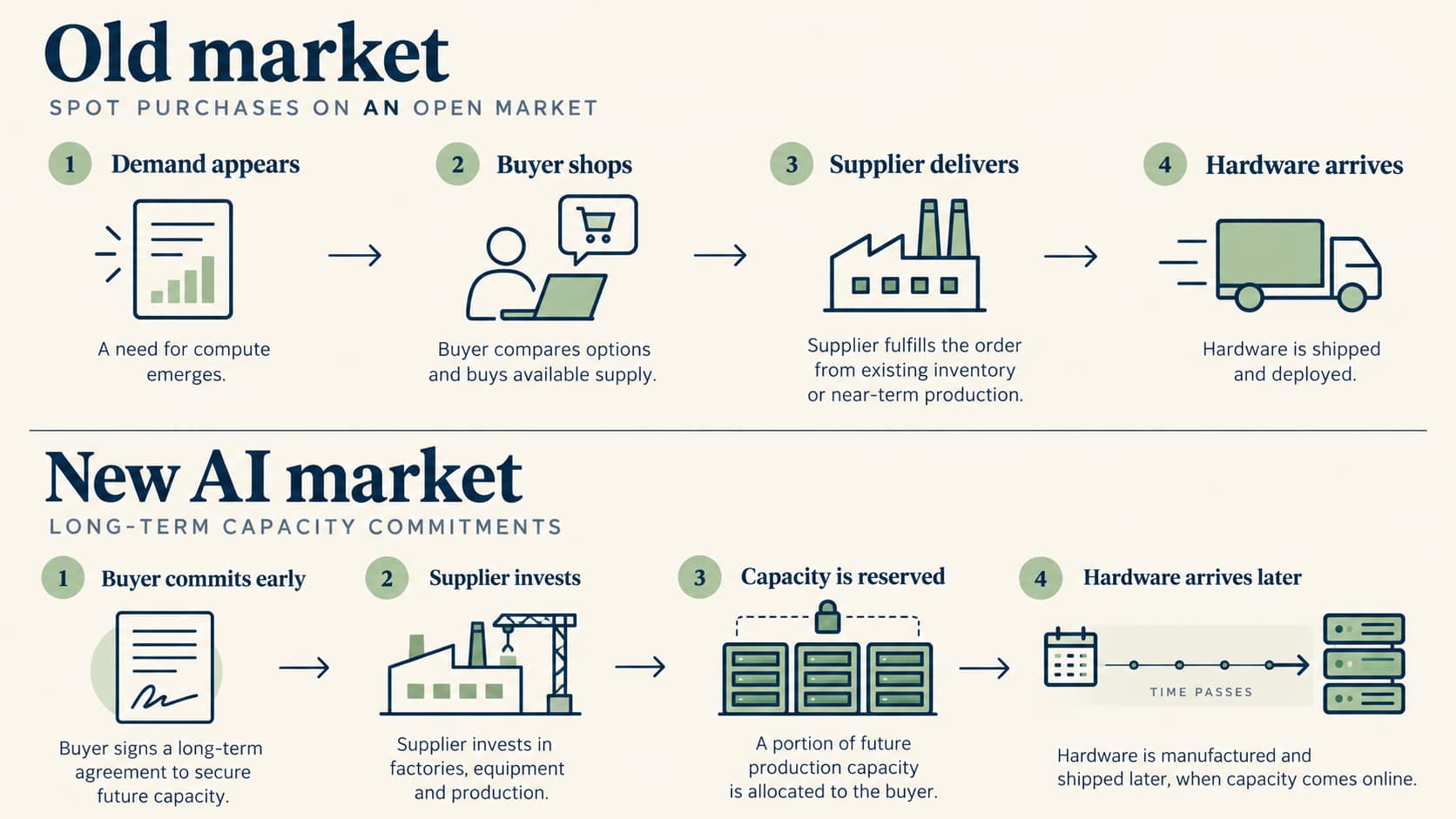
As photonics becomes part of the system design, the commercial model changes with it. Hardware that must be qualified and integrated years before deployment cannot be treated like something buyers simply source when demand appears. Future availability starts to matter almost as much as current price.
That is already visible in the way large AI companies are contracting for optics. NVIDIA’s multiyear agreement with Coherent includes significant purchase commitments as well as rights tied to future production capacity [4]. The arrangement is more than a procurement contract. It gives the buyer visibility over a component that could otherwise become scarce just as new infrastructure comes online, while giving the supplier a clearer basis for investing ahead of demand.
The wider implication is that AI hardware markets are becoming less open at the point where scale matters most. Access increasingly depends on who committed early enough to be inside the production plan. That changes the competitive equation. The next AI cycle will not be determined only by who can afford the most processors, but by who secured the optical capacity required to make those processors work together before the market tightened around it.
Sources: