L’Oréal has moved ahead of LVMH in market value at a moment when premium consumption is becoming more selective. On September 15, the beauty group was worth about €203 billion, compared with roughly €201 billion for LVMH.[1] The difference reflects a sharp split in share performance this year: L’Oréal is up around 5%, while LVMH has fallen about 35%.[1]
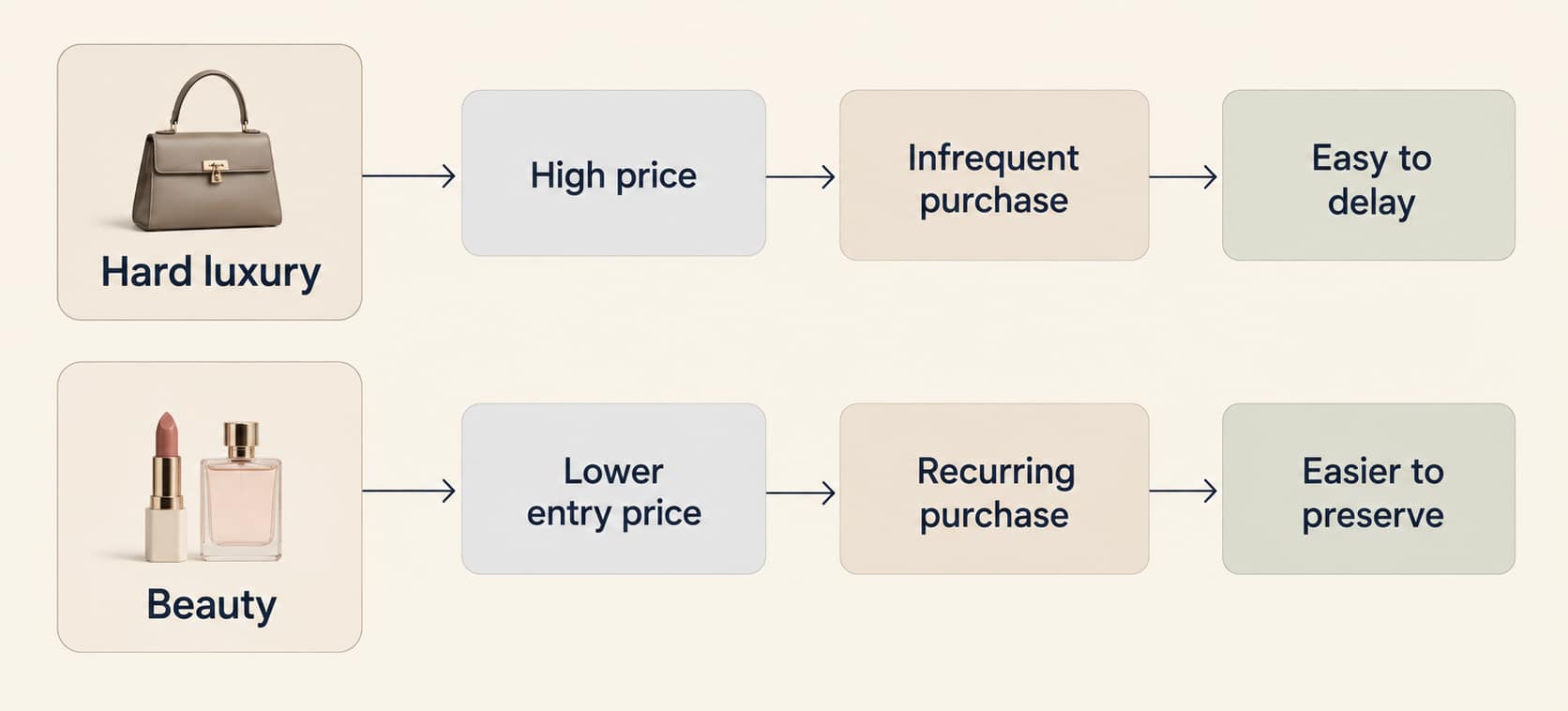
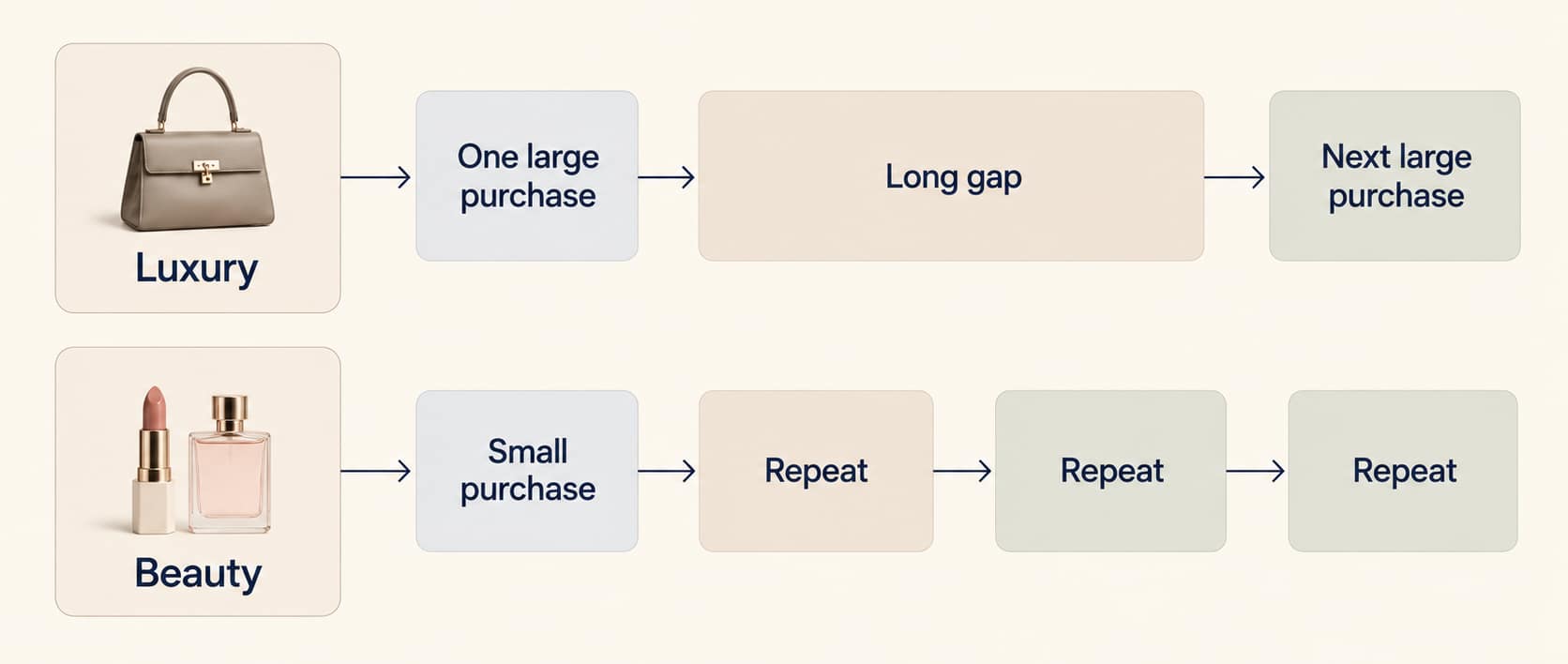
The gap is not only about brand strength. It reflects two different ways consumers spend discretionary income. A handbag, watch or piece of jewelry requires a large purchase that can be delayed easily. Beauty products sit much lower on the spending ladder and are bought more often. That makes the category easier to preserve when consumers start cutting back without leaving premium brands entirely. The market-cap crossover captures that difference in economic terms: smaller purchases can hold up better when the discretionary wallet tightens.
The Economics of Affordable Indulgence
Beauty works on a different spending rhythm. High-ticket transactional commitments can vanish from a household budget with a single decision to wait. Premium skincare, fragrance and makeup are harder to cut in the same way because spending is spread across smaller purchases made throughout the year.
The revenue effect is less binary. A beauty customer can spend less without leaving the category altogether — trading down within a brand portfolio, buying less often or choosing a lower-priced product while remaining part of the same customer base.
For companies, that creates a more flexible pricing architecture. Beauty groups can defend premium positioning across multiple price points instead of relying on a single large transaction. As the limits of price pass-through become more visible, that structure gives beauty brands a simpler way to absorb softer spending: it acts as an economic shock absorber, preserving the customer relationship at a lower financial entry point.
Pricing Power Meets Purchase Frequency
The first-half numbers show how differently those spending patterns can flow through a business. L’Oréal increased like-for-like sales by 6.8% in the first six months of 2026, while operating margin increased by 20 basis points to 21.3%.[2] Dermatological Beauty grew 11.3% and L’Oréal Luxe added 5.4%.[2] LVMH’s Fashion & Leather Goods division moved the other way: organic revenue fell 1% over the half, although the business returned to 1% growth in the second quarter.[3]
Brand strength alone does not explain the split. LVMH still has considerable pricing power, but a larger share of its fashion business depends on customers making expensive, less frequent purchases. L’Oréal operates across a wider range of price points and categories where purchases recur more often.
That does not make beauty immune to weaker consumer demand. It does make the revenue base less dependent on a small number of large spending decisions. In a cautious market, that distinction can support both sales growth and margin without requiring every customer to keep spending at the same level.
The Battle for the Discretionary Wallet
The more important shift is in how premium consumer businesses are being valued. Category leadership alone says less than it once did about the quality of future earnings. Investors increasingly have to ask how exposed a company is to changes in household confidence, financing conditions and the timing of discretionary purchases.
That broadens the competitive field. L’Oréal is not only competing with other beauty groups, just as LVMH is not only competing with other luxury houses. Both ultimately depend on how much income consumers are willing to leave uncommitted after housing, food, travel and other major expenses. The relevant market is therefore larger than any single product category.
For premium companies, that may change where capital is deployed. Brand investment will remain central, but portfolio structure, category mix and the ability to participate across different spending occasions become more important to earnings stability. As the growing limits of price pass-through redefine how companies manage margins and volume, L’Oréal’s rise above LVMH is one snapshot of that repricing: the market is assigning greater value to businesses that can remain embedded in discretionary spending even as the composition of that spending changes.
Sources:
[1] Reuters — L’Oréal steals French stock market crown from LVMH
[2] L’Oréal Finance — 2026 Half-Year Results
[3] LVMH — Accelerating Growth in the Second Quarter — Solid First-Half Results