How Brands Can Sell Value Without Sounding Expensive


Editor-in-chief at Vireon Press, covering business and technology through the lens of strategy, efficiency, and real-world consequences.
Price sensitivity is rarely just a shortage of capital. In modern markets, it is often a defensive reaction to accumulated skepticism. Enterprise buyers and practical consumers have learned to stop reading brand manifestos and start calculating line-item utility.
The instinct under economic pressure is familiar. Brands try to protect margins by changing the narrative, attempting to sell value without discounting. But that strategy hits a hard wall when the value remains vague. Buyers routinely audit for software bloat, short hardware lifespans, and post-sale support failure. They do not price risk based on vendor optimism. When an invoice lacks infrastructure proof, the structural premium reads as an unvouched markup.
Value cannot be declared through creative direction alone. It has to be built into the product, clarified in the offer, and made visible before the buyer feels asked to believe too much.
Why “Premium” Language Often Fails
The word “premium” has lost much of its structural meaning. It no longer tells the buyer what was engineered better, what lasts longer, or what failure costs have been removed. The term functions as a default mask for an unexplained price hike.

This lack of data triggers immediate rejection. Gartner’s 2025 data confirms that 61% of B2B buyers mandate an entirely rep-free evaluation process. [1] They isolate and vet specifications long before line-of-business managers authorize vendor sales calls.
In that environment, adjectives have very little economic value. “World-class,” “next-generation,” and “frictionless” sound expensive, but they do not explain the price.
A software vendor that promises a seamless experience without publishing integration requirements or support terms leaves the buyer to price the risk alone. A retailer calling ordinary materials elevated creates the same problem. So does a service firm describing routine delivery as bespoke.
The buyer is not asking for a better mood. They are asking what the premium removes, improves, or protects.
What Makes Value Easier to Believe
To make a higher price believable, a brand has to stop describing quality and show what the buyer is actually paying for. Value becomes credible when it can be traced to a practical result, a lower operating cost, or a risk removed from the customer’s side.
The first proof is measurable performance. If a component lasts twice as long, it needs replacing less often. If a service cuts a weekly process from four hours to one, the buyer can compare the fee with the labor saved. In software, the useful evidence may be faster processing, fewer support escalations, or minimized system disruption. These are not aesthetic claims. They give the premium somewhere solid to stand.
Transparent terms carry the same weight. The FTC’s fee rule requires specific sectors to display total prices upfront rather than allowing mandatory charges to surface late. [2] While the regulatory mandate is narrow, delayed cost disclosure universally invalidates transaction math.
Premium pricing also requires verifiable operational enforcement. To hedge against system failure, an offer must specify direct engineering access, clear escalation paths, and enforceable service-level agreements.
Social proof has to be just as concrete. Praise is weak evidence. Akeneo’s 2025 research shows that two-fifths of buyers desert transactions when product specifications fail to match operational reality. [3] A useful case study bypasses mood and shows what changed after the purchase: audited engineering logs, optimized diagnostic cycles, and verified stability metrics.
How to Talk About Price Without Defending It
Defending a price becomes a strategic error when explanation turns into an apology. The moment a brand sounds uncertain about what it charges, the buyer treats the number itself as a structural flaw. Clean price communication breaks the cost apart rather than trying to justify it.
A higher price becomes easier to read through Total Cost of Ownership (TCO). The upfront invoice is only the visible cost. A cheaper alternative may carry unpredictable maintenance cycles, missing integrations, security gaps, retraining, or sudden downtime. The initial saving disappears once the buyer has to keep the asset operational.
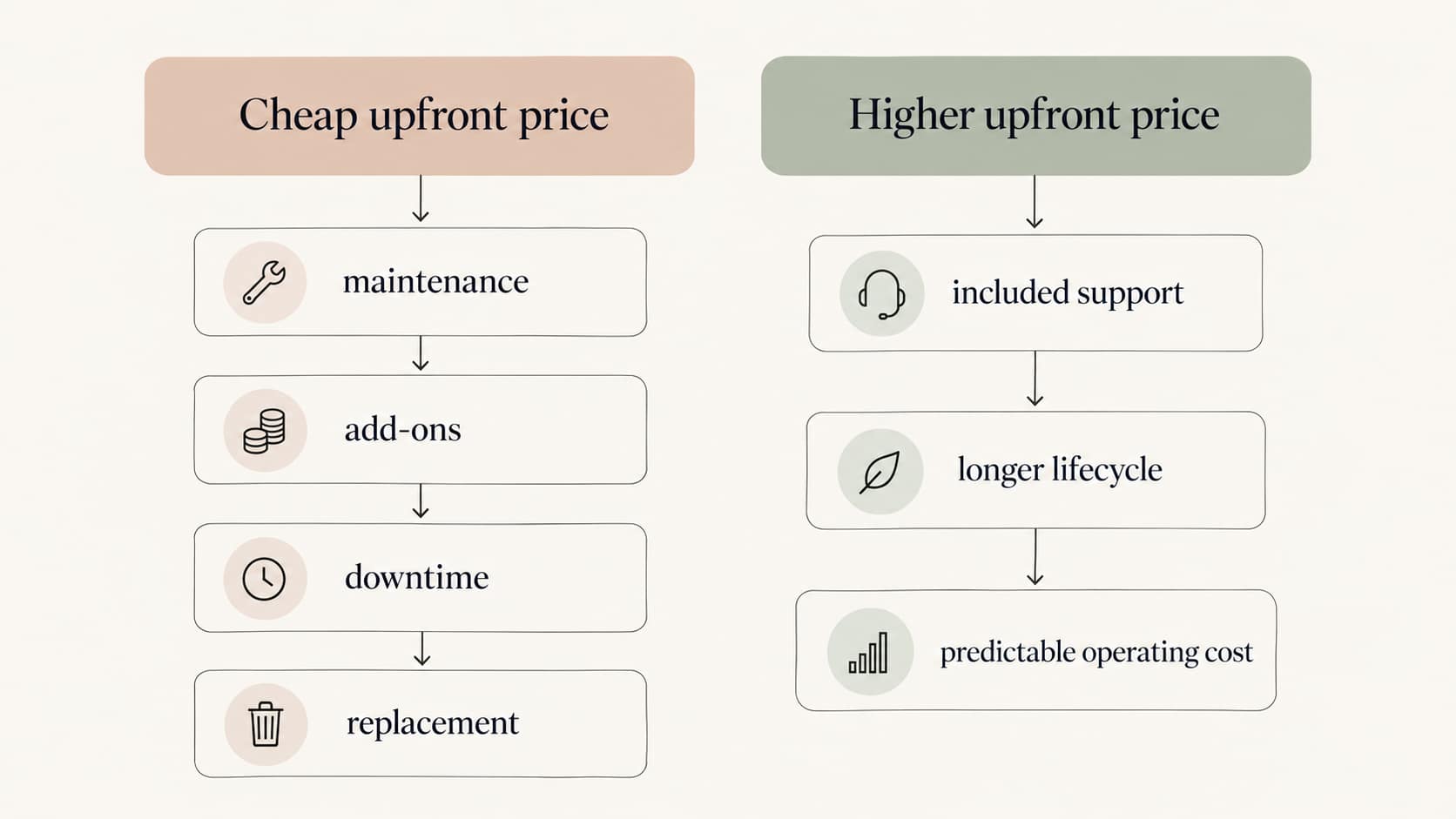
A professional offer should state what sits inside the core price: processing capacity, implementation, direct support access, updates, security, and contract terms. It should also make clear which costs will not surface later as add-ons.
Comparisons work best when they stay factual. Do not claim vague superiority. Compare replacement cycles, service hours, recurring fees, and downtime. Show the math. Buying one stable asset can be cheaper than cycling through three low-cost alternatives that produce technical debt and repeated operational friction.
At that point, the brand is no longer defending the price. It is showing the buyer what the cheaper option may eventually cost.
Where Brands Often Overdo It
Brands usually become loudest when the product is doing too little work. The specifications disappear, and in their place come statements about identity, purpose, and transformation.
Practical buyers notice. Brand films and polished retail staging are easy to produce. Evidence is harder. A mid-market company can borrow the visual codes of luxury, but the effect collapses the moment the buyer asks what changed in the product itself.
Fear messaging runs into the same wall. A cheaper option may carry real technical or regulatory risk, but the brand has to name it. Vague warnings about compromise, failure, or being left behind read as a sales maneuver, not protection.
Mood has a place. It just cannot carry the entire price. When the product lacks clear tolerances, measurable output, dependable support, or firm service terms, lifestyle language starts to look like cover.
The Easier Audit

Value does not require a louder argument. It requires an easier audit. A brand does not protect its margin by making the customer feel better about spending more. It protects it by making the higher price look like the safest variable on the spreadsheet.
That changes the role of marketing. The job is no longer to manufacture prestige around the number, but to reduce uncertainty around what the number buys: extended lifecycles, baseline predictability, open documentation, and reduced exposure to downstream risk.
When price communication stays specific, the premium stops looking arbitrary. It reads as insulation against future expense. The objective is not to sound expensive. It is to make the financial logic of the higher price easier to verify.
Sources:
[1] Gartner. Gartner Sales Survey Finds 61% of B2B Buyers Prefer a Rep-Free Buying Experience (2025).
[2] Federal Trade Commission. Rule on Unfair or Deceptive Fees to Take Effect May 12, 2025.
[3] Akeneo. Top Takeaways From Our Global B2C Survey Report (2025).
Editor-in-chief at Vireon Press, covering business and technology through the lens of strategy, efficiency, and real-world consequences.

The Schneider PTC Deal and the New Industrial Business Model


The In-House Premium: GE Aerospace and the Return of Vertical Integration

Shein’s $26B Reality Check: Why Fast Logistics Is Getting Expensive

The Warehouse Correction: America’s Logistics Boom Meets Real Demand

The Water Constraint: Europe’s New Corporate Map
Advertisement