
Editor-in-chief at Vireon Press, covering business and technology through the lens of strategy, efficiency, and real-world consequences.
Some companies that cut jobs expecting artificial intelligence to take over are now looking for people to fill those roles again.
AI has made many routine tasks faster. That was part of the attraction for businesses looking to operate with smaller teams. But saving employees time and eliminating their jobs are two different calculations. Some employers are now discovering how difficult that distinction can become when they put it to the test.
The reversal also raises questions about the savings companies reported when they first reduced their workforces. A lower payroll bill may have reflected a transfer of costs rather than their elimination.
When AI Layoffs Meet Reality
Klarna initially presented its AI assistant as a major efficiency gain. By February 2024, it was handling two-thirds of customer service chats. But Klarna’s subsequent return to a greater emphasis on human support exposed a weakness in that calculation: the volume of inquiries handled says little about the value of problems successfully resolved. For a payments business dependent on repeat transactions, a cheaper service operation can become costly if customers lose confidence in it.
Ford’s decision to hire or promote 350 experienced engineers in June 2026 points to a different accounting problem. The move was aimed at improving vehicle quality, not reversing documented AI layoffs. Engineering expertise can be expensive to retain, but a defect identified before production costs far less than one discovered after thousands of vehicles have been sold. The financial value of that expertise may be greatest when nothing goes wrong — an outcome that is difficult to capture in conventional productivity figures.
Recruitment firm Robert Half has encountered employers reopening positions eliminated in connection with AI adoption. Unlike the corporate examples, these cases bring the staffing decision itself into focus. Employers are returning to the labour market for work they had expected to absorb through automation, suggesting that the anticipated reduction in labour demand did not materialise as planned.
There is not yet enough evidence to determine how common such reversals are [1].
Automating Tasks Is Not Replacing Jobs
The uneven results of AI adoption suggest that some companies may have misidentified where the savings would come from.
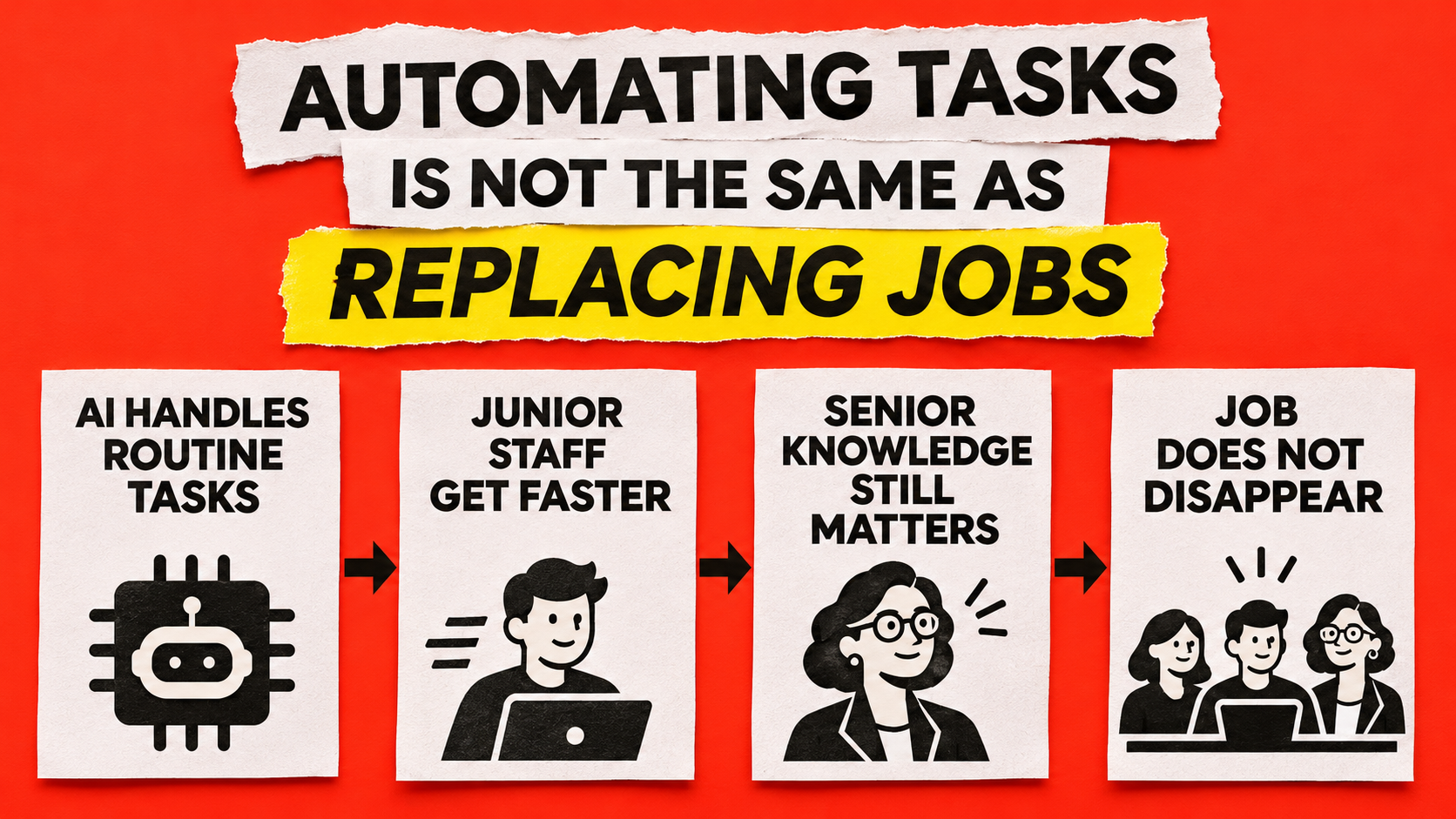
A study of 5,172 customer support agents published in The Quarterly Journal of Economics found that generative AI increased productivity by roughly 15% on average. Less experienced employees recorded the largest gains, while the most experienced saw little improvement [2].
The pattern points to a change in the economics of experience. AI allowed newer agents to draw on practices that previously took years to acquire, reducing the performance advantage of longer-serving colleagues in routine customer interactions. But it did not follow that the same proportion of senior positions had become unnecessary. Their knowledge was helping generate the improvement elsewhere in the workforce.
When Faster Work Doesn’t Cut Costs
Even where AI saves time, the financial return can be difficult to locate. In a study published by the National Bureau of Economic Research, employees using generative AI spent roughly two fewer hours a week on email. Yet researchers found little change in how work was distributed across the companies involved. The time saved on correspondence had not translated into a broader reorganisation of work [3].
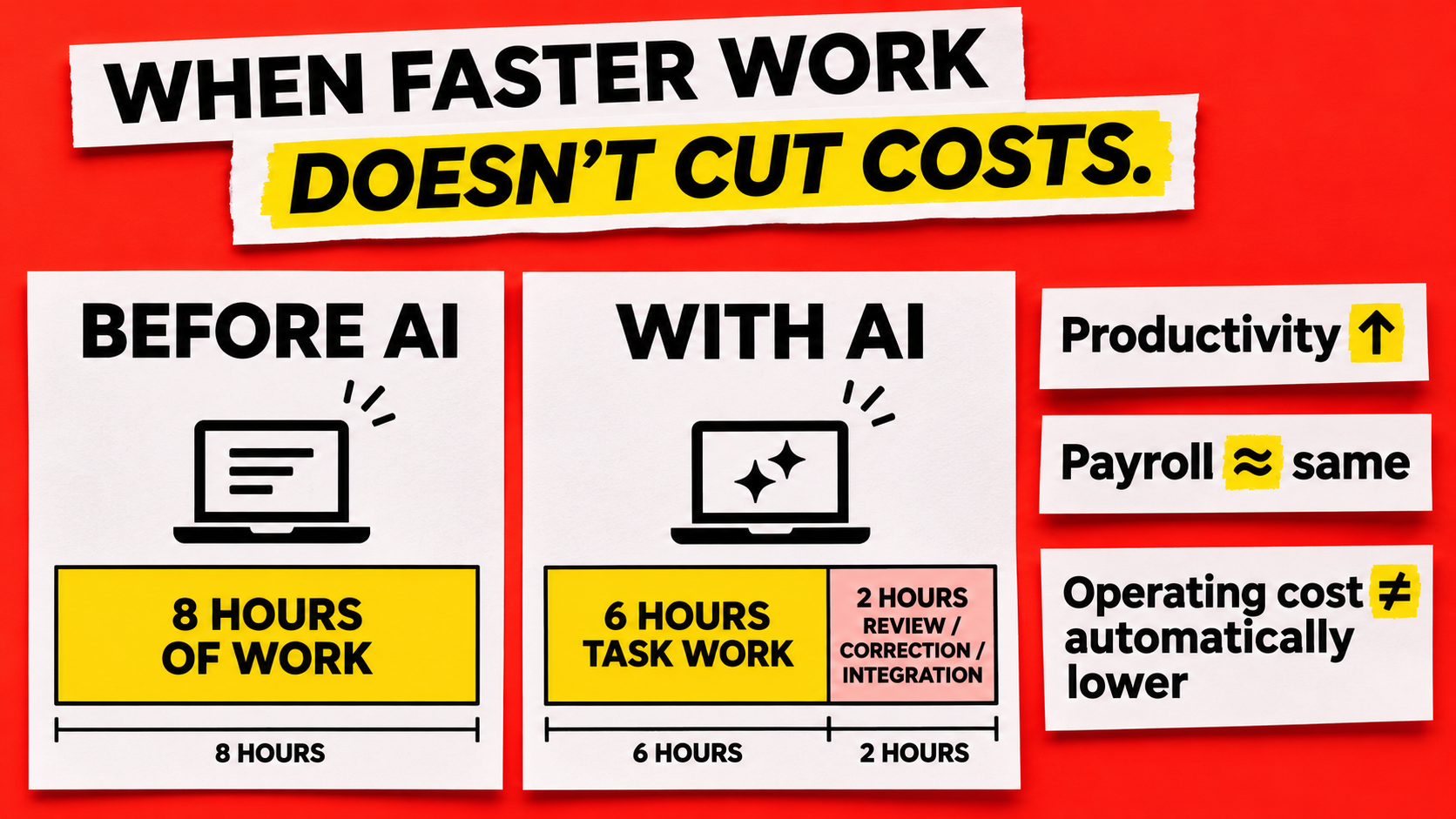
For employers, that leaves a gap between improved individual performance and lower operating expenses. A shorter working week was not the result, nor was a measurable reduction in staffing. The benefit remained largely within the existing working day, where it could be absorbed by other demands.
The economics can be less favourable when AI introduces work of its own. In an experiment involving experienced open-source developers, researchers at METR found that participants took 19% longer to complete tasks with AI assistance, despite believing it had made them faster. Generating code was only part of the process; reviewing suggestions and fitting them into established projects could outweigh the time saved at the outset [4].
The specialist time needed to check AI outputs also carries a cost. With companies already facing higher capital costs, that expense can materially alter the return on an automation investment.
When AI Layoffs Reshape the Labour Market
AI could also alter the supply of skills that companies expect to find when they return to hiring. Routine work has long served as an entry point into occupations where experience commands a premium. Reducing those positions may leave employers with fewer junior salaries to pay, but also fewer people developing the expertise needed for senior roles.
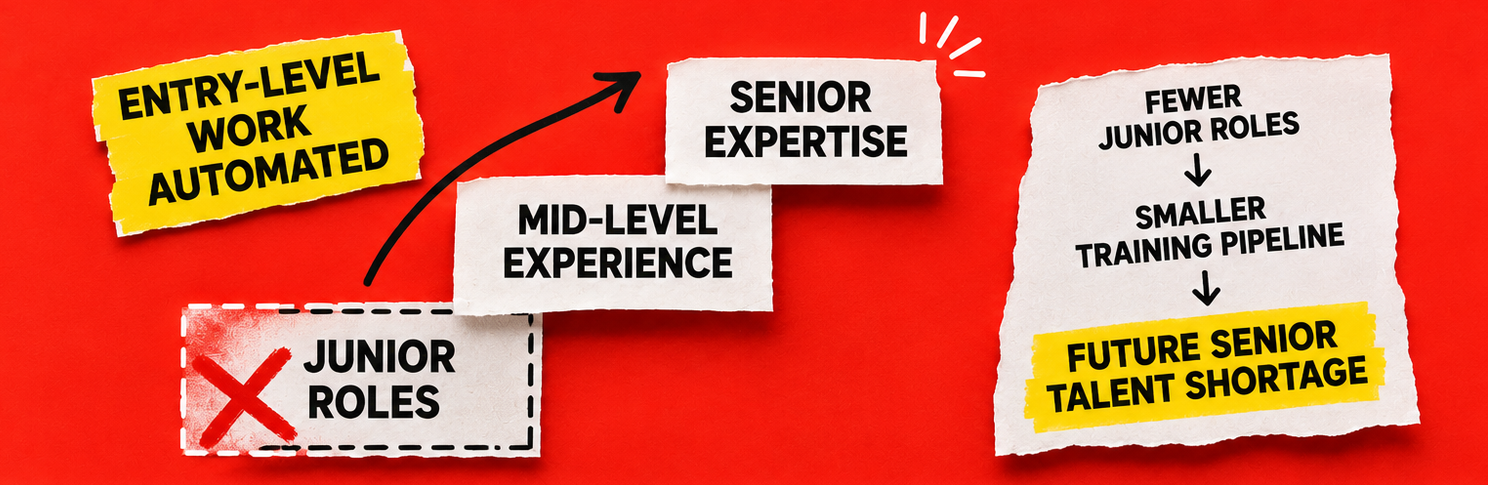
The effects would take years to become visible. In engineering and finance, junior employees acquire judgement through work that also gives companies a reason to employ and train them. As AI takes on more of those assignments, the business case for maintaining such positions may weaken, even where the need for experienced specialists remains.
Companies that continue investing in junior staff would then carry more of the cost of developing future talent. Their competitors could reduce training expenses in the short term and still recruit experienced workers from the same labour market.
What the AI Boomerang Reveals About Business
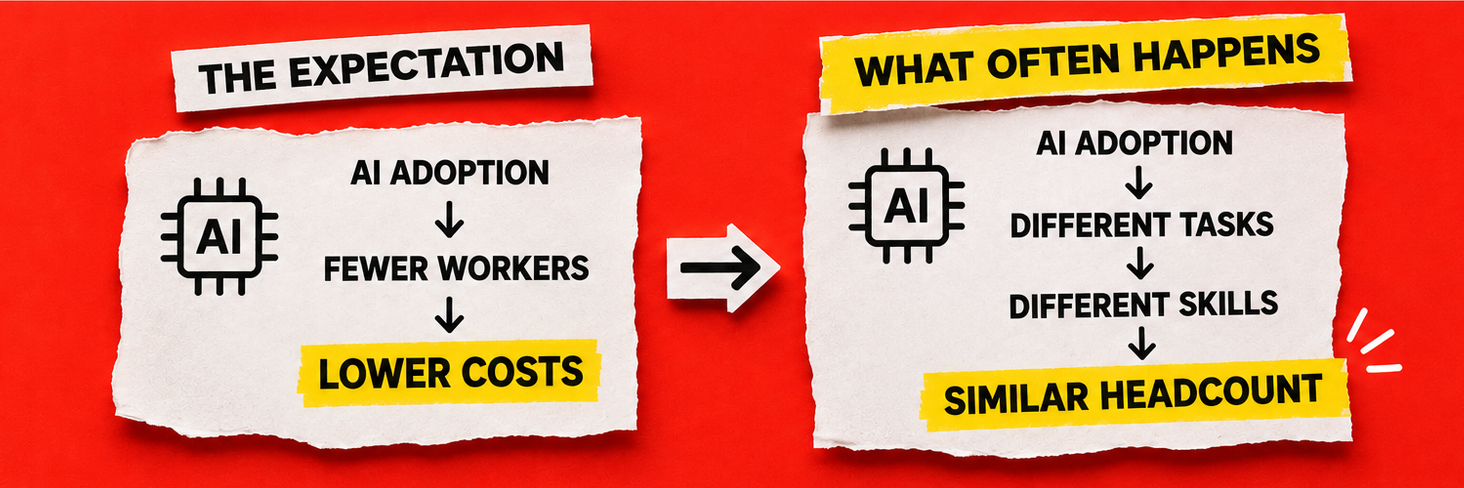
The employment figures offer little support for the idea that AI adoption has already produced a broad reduction in the need for workers. In Firm Data on AI, researchers surveyed executives at nearly 9,000 companies across seven countries. Respondents reported almost no net effect on employment from AI over the preceding three years [5].
The contrast with corporate announcements of workforce reductions is revealing. Employers may be changing the composition of their workforces without substantially reducing their size. The technology can make some positions less necessary while increasing the value of skills required elsewhere.
The companies bringing workers back have encountered that uncertainty in practice. Their experience does not make a case against automation. It suggests that the financial case for replacing employees cannot be settled by what software is capable of doing. It depends on what a business can afford to lose when those employees leave.
Sources:
[1] Cathy Bussewitz. “What to Consider if a Company That Made AI-Related Job Cuts Wants You Back.” Associated Press, October 2026.
[2] Erik Brynjolfsson, Danielle Li and Lindsey Raymond. “Generative AI at Work.” The Quarterly Journal of Economics, 2025.
[3] Eleanor W. Dillon, Sonia Jaffe, Nicole Immorlica and Christopher T. Stanton. “Shifting Work Patterns with Generative AI.” National Bureau of Economic Research, Working Paper No. 33795, 2025.
[4] Joel Becker, Nate Rush, Beth Barnes and David Rein. “Measuring the Impact of Early-2025 AI on Experienced Open-Source Developer Productivity.” METR, July 10, 2025.
[5] Ivan Yotzov et al. “Firm Data on AI.” National Bureau of Economic Research, Working Paper No. 34836, February 2026, revised October 2026.
Editor-in-chief at Vireon Press, covering business and technology through the lens of strategy, efficiency, and real-world consequences.


Building Before the Demand: ASML’s Long-Term Semiconductor Bet

The End of the Open Market: When AI Starts Buying Years Ahead

When Infrastructure Needs a Passport: Inside the New US Power Grid Rules

Why Smart Devices Still Feel Less Smart Than Promised

Advertisement