Retirement in Installments: Why Modern Workers Are Pausing


I'm writing about beauty and celebrity culture for Vireon Press, tracking how trends evolve across fashion, media, and public life.
Retirement has always depended on a peculiar bargain. You give work most of your adult life, and time is supposed to be waiting at the other end. Not just free time. Healthy time. The kind you can still use.
By 2026, that promise feels harder to trust. Pension thresholds move. Companies restructure. A long stretch of service can end with a brief meeting and a locked account. The old post-work milestone is still there, but it no longer looks quite as solid.
The micro retirement trend operates on tighter parameters. Workers are taking some of that promised freedom earlier, in smaller pieces. The pause might be used for travel, study, family care, or recovery from a pace that had stopped feeling sustainable.
They are not trying to leave working life behind. They are questioning why every substantial break must wait until the end of it. When stability already feels uncertain, postponing all freedom until 65 begins to look like a risk of its own.
What a Micro-Retirement Looks Like
A micro-retirement does not fit neatly into the usual language of workplace absence. A traditional sabbatical is arranged through an employer, often after a long period of service, with the expectation that the employee will return.[1] Unemployment arrives under different circumstances. It is rarely chosen or timed.
A micro-retirement falls between the two. It is planned, usually self-funded, and taken with the understanding that work will resume later — though not necessarily in the same role or field.
Reuters reported in May 2026 on young professionals taking these breaks during their working lives rather than waiting for conventional retirement.[2] The pauses were not all built around beaches and open-ended travel. Some people used the time for family care. Others studied, reconsidered their careers, or stepped away before exhaustion became the background of daily life.
The financial preparation is clinical. Savings once treated as untouchable are being used to buy several months of time in the present.
From the outside, an extended break can look indulgent. For the person taking it, the calculation may be simple: pause now, or risk needing a much longer recovery later.
Why the Traditional Career Timeline Is Losing Its Authority
The old career timeline depended on continuity. Stay long enough, become valuable, move upward, and eventually collect the security that loyalty was supposed to earn.
That exchange is less convincing now. Among American workers aged 25 to 34, median tenure with an employer is now 2.7 years.[3] Early career stretches have shortened to the point where building a life inside one institution is no longer a viable plan. Ten years with one company offers no protection from a sudden layoff or a leadership turn that erases the role completely. The demands of the job are clear and immediate; its long-term promises are abstract.
Exhaustion arrives on Tuesday, but recovery is supposed to wait for a distant milestone. When Gallup’s 2026 data shows that 40% of employees globally experience significant daily stress, strain ceases to be an anomaly.[4] It is simply the background of the workweek. A promotion in that environment can feel strangely empty. A new title may bring more visibility and responsibility, but very little additional control over time.
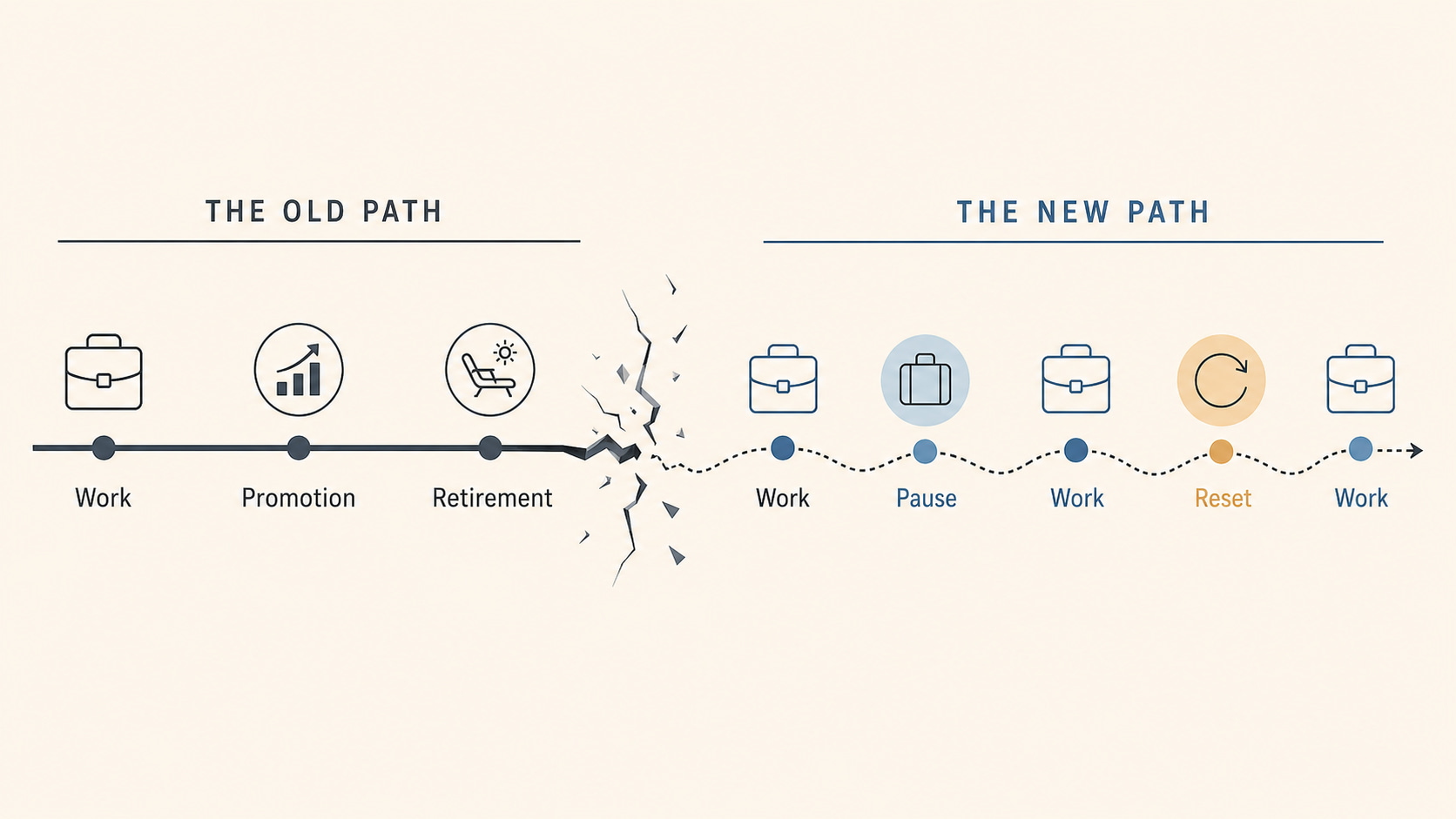
That control is becoming harder to dismiss. A month without meetings is a month. An afternoon that belongs entirely to you cannot be replaced by a promise of flexibility later. For workers moving through shorter stretches of employment, the ability to step away may feel more valuable than another promotion whose rewards remain uncertain.
The Cultural Move Away From Deferred Living
For a long time, adulthood was organized around postponement. Youth supplied the energy. Work consumed it. Freedom came afterward.
Micro-retirements disturb that sequence. They place leisure, care, and recovery inside working life rather than at its conclusion. Careers begin to look less like one uninterrupted narrative and more like separate periods, with space between them.
Online culture has made those pauses visible, though not always honestly. Career breaks appear as sunlit rooms, slow trains, notebooks on café tables. The image is sold through the same manufactured closeness explored in parasocial relationships in the age of influencers: someone else’s escape becomes intimate enough to imagine as your own.
The frame rarely includes the cheaper apartment, lost health coverage, or the spreadsheet beside the plane ticket.
Time changes value as a person ages. Six free months at 32 are not interchangeable with six free months at 72. The calendar may count them equally. The body does not.
A pause is no longer treated only as an empty space in a career. It can become part of the career itself. Rest is no longer held back entirely as a prize for endurance. It appears earlier and unevenly, while there is still a life around it to shape.
Who Can Afford the Pause

The freedom to step away is not distributed evenly. Online, an extended career break can look like a simple choice. In practice, six months without a salary usually depends on savings, manageable debt, and a buffer that is easy to omit from the story: a partner’s income, low housing costs, or family support.
For many workers, an unpaid gap is not a reset. It is a financial threat.
High incomes do not eliminate the friction. A gap on a resume still requires navigation during a traditional interview, and fast-moving fields penalize even six months of absence. Without a strict financial buffer, a mini-retirement simply narrows future choices.
The lifestyle narratives market time autonomy as a universal right, but the math remains highly restrictive. The transition requires liquid capital, not just a shift in mindset. In practice, access to a career pause is dictated by existing privileges: parental backstops, a partner’s salary, a low mortgage, or a niche skill set that ensures an easy return.
The New Autonomy
The rise of retirement in installments is a quiet renegotiation of the life cycle itself. The old promise is becoming harder to organize a life around. Tenure can disappear in a restructuring. Loyalty may offer no protection. Pension rules can shift long after the sacrifice has already been made. Some workers are taking back a portion of the time they were expected to save for later.
What counts as stability is changing with it. Staying on a single track until 65 offers predictability, but a predictable trajectory is not a hedge against exhaustion. A career path can remain perfectly intact on paper while the individual holding it faces complete physical and emotional depreciation. Micro-retirements do not remove risk. They show that never pausing can carry its own.
Sources:
[1] CIPD. “Sabbaticals: Guide for People Professionals.” May 18, 2026.
[2] Reuters. “Why More Young People Are Taking Mini-Retirements.” May 29, 2026.
[3] U.S. Bureau of Labor Statistics. “Employee Tenure in 2024.” September 26, 2024.
[4] Gallup. “Global Data Summary — State of the Global Workplace 2026.”
I'm writing about beauty and celebrity culture for Vireon Press, tracking how trends evolve across fashion, media, and public life.

Why Thrift Stores Are Booming Right Now

Why Everyone Wants a Personal Brand Now

How Social Media Made Taste Feel More Predictable

Work Life Balance: Why It Feels Harder Than Ever

Parasocial Relationships in the Age of Influencers

Minimalist Lifestyle: Simplicity as a Form of Control
Advertisement