How Companies Lose Revenue Through Poor Onboarding


Editor-in-chief at Vireon Press, covering business and technology through the lens of strategy, efficiency, and real-world consequences.
A signed contract is often treated as the finish line. Sales celebrates the closed deal, marketing records the acquisition, and finance registers the incoming contract value. But in modern business operations, the close of a sale does not eliminate revenue risk. It merely moves that risk to another department.
If the customer’s first experience with the product is weak, the revenue won by sales begins to dissolve almost immediately.
This is the operational trap behind poor customer onboarding. A company can spend months optimizing its acquisition funnel, only to lose the customer within the first forty-eight hours of setup. Customers rarely abandon a platform because its core technology is fundamentally useless. They walk away because the early experience fails to make that utility clear, turning verified closed-won accounts into unstable and volatile contract value.
Why Onboarding Is More Than a Welcome Email
A welcome email can look like onboarding from inside the company. The message is sent, the help center link is included, the account is created, and the dashboard is waiting. On paper, the customer has everything needed to begin.
From the customer’s side, the picture is less tidy. The first impression forms quickly. Either the product feels guided and usable, or it starts to look like another internal project the customer has accidentally bought.
A blank dashboard is not a neutral space. It asks the user to decide what matters first, which settings can wait, which integrations are urgent, and how much of the afternoon setup will consume. In a complex B2B product, that is not orientation. It is unpaid implementation work pushed onto the buyer.
The customer onboarding process has a more specific job. It should create early control before attention starts to break. The user needs to see what happens first, why that step matters, and when the product will begin producing value. Without that clarity, even a strong platform can feel expensive before it feels useful.
Where Poor Onboarding Costs Money
Financial loss from a weak initial experience rarely appears as one clean drop at the end of the year. It leaks out earlier, usually across the first thirty days. When a customer struggles to configure an account, the cost of acquisition turns into a new chain of operating expenses.
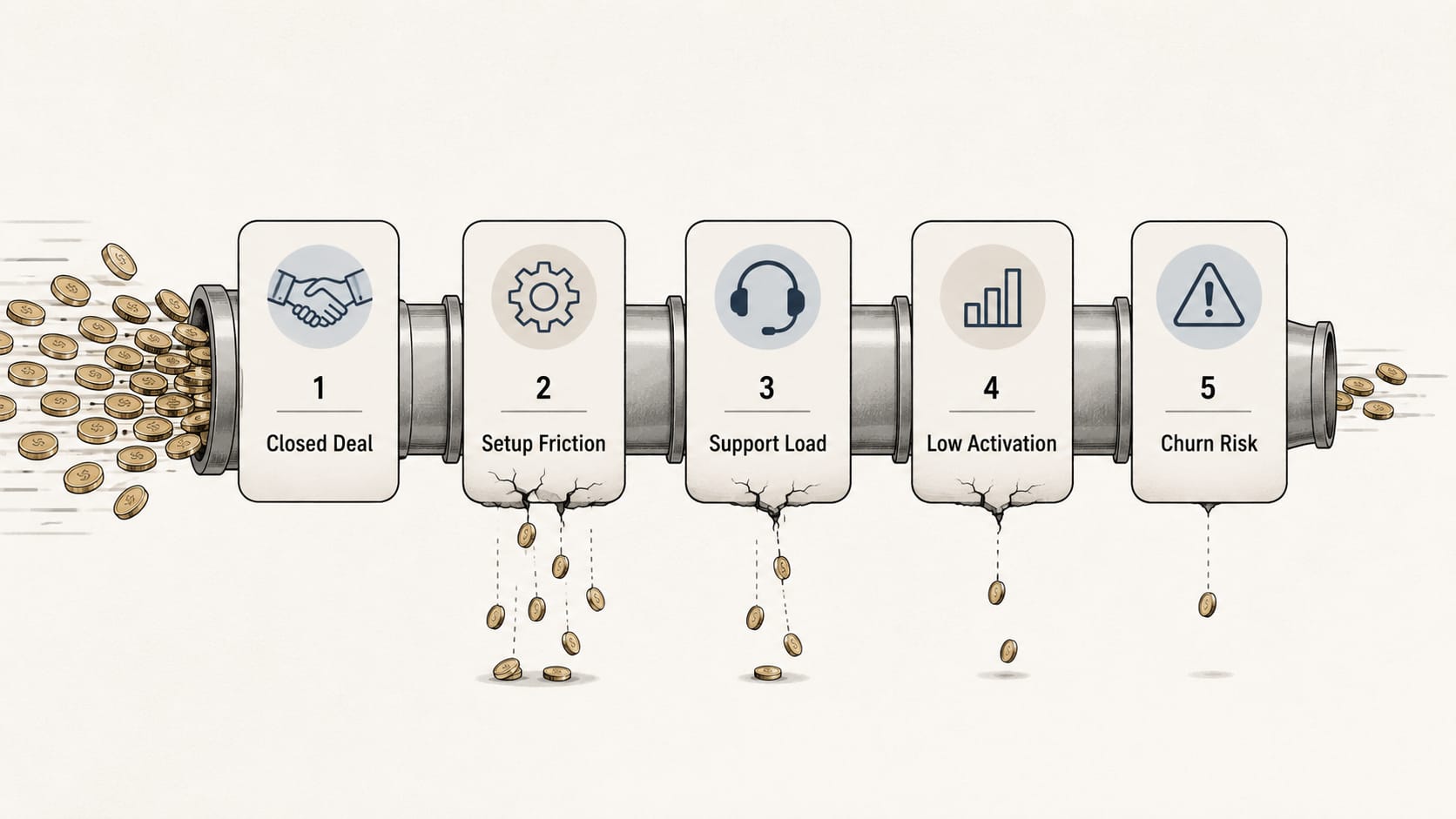
The first drain hits customer success and support. A confused user does not quietly study the product. They open tickets. They ask how to connect an integration, import data, invite a team, reset permissions, or locate the feature they thought they had bought. Support engineers then spend paid hours correcting basic setup friction instead of protecting larger accounts or handling problems that actually require expertise.
The deeper damage shows up in activation. OnRamp and TrendCandy’s onboarding research found that many customers abandon onboarding when value is not visible quickly. [1] Amplitude’s product benchmark work makes the same point from the usage side: early activation is closely tied to later retention. [2] Pendo’s 2025 retention benchmarks also show how quickly product usage can decay after the first month. [3]
By then, the revenue problem is no longer theoretical. Low activation becomes slow adoption. Slow adoption becomes refund requests, first-month cancellations, and avoidable churn. Poor customer onboarding forces the company to keep replacing revenue it had already paid marketing and sales to win, driving automated operational loops that mirror wider enterprise trends toward corporate overconsumption.
What Good Onboarding Should Clarify
Effective onboarding does not need to look impressive. Its job is simpler and harder: to create certainty before the customer loses momentum. A newly closed account needs to know what happens first, who owns each step, and where the first useful result should appear.

The first question is process ownership. If implementation depends on the customer’s IT team, finance lead, operations manager, or data owner, that responsibility has to be visible early. Ambiguity delays setup. Delay makes the product look heavier than it is.
The second question is feature priority. A new customer does not need to see every advanced capability on day one. They need a narrow path through the parts of the product that prove the purchase was reasonable. The rest can wait.
The third question is success. Good onboarding should define the first milestone clearly enough that the customer recognizes it when it happens. A report generated, a payment processed, a workflow automated, a dashboard populated with usable data. This moment shortens time-to-value, establishing the baseline infrastructure needed to validate the initial contract spend long before quarterly contract reviews occur.
How Companies Can Improve the First Experience
Fixing the post-sale leak means removing friction from the first useful path. The initial login should not feel like an open invitation to explore. It should move the customer toward one specific milestone.
Shorter setup paths help. Companies can remove unnecessary fields, pre-fill workspaces, simplify data import, and delay complex administrative settings until after the customer has seen the product function. A sandbox view or prepared template can show value before the buyer has to complete a full migration, eliminating the hidden cost of digital convenience that backfires when complex systems are left entirely open.
In-product guidance should also be more precise. Long training videos and static documentation often ask too much from a busy user. Contextual prompts work better when they appear at the moment of action: connecting an account, building a report, inviting a teammate, or completing a payment setup.
For high-value enterprise accounts, automation should not carry the whole process. A short technical or customer success check-in can catch configuration errors before they become frustration, support tickets, or cancellation risk—shielding complex enterprise users from the operational detachment common in purely automated parasocial relationships in the age of influencers.
These adjustments change the economics of the first week. Each path should end with a visible success milestone, not just another setup screen. The goal is not to teach every feature. It is to secure user activation before the customer’s attention returns to other operational problems.
The Revenue Protection Layer
Growth cannot depend only on expanding the top of the sales funnel. When acquisition costs rise, the more urgent question is how much closed-won revenue survives the first forty-eight hours of use.
Customer onboarding is not a polite administrative greeting. It is a revenue protection layer. A company cannot build stable retention while support teams absorb basic setup errors and new users quietly drift toward cancellation.
Good onboarding protects the financial runway that marketing and sales already paid to create. The product that wins is often the one that proves value first, then lets the customer return to work.
Sources:
[1] OnRamp & TrendCandy. The First 90 Days: Why Customer Onboarding is the New Battleground for Customer Retention (2025).
[2] Amplitude. The Product Benchmark Report / Time to Value Drives User Retention (2025).
[3] Pendo. SaaS churn and user retention rates: 2025 global benchmarks (2025).
Editor-in-chief at Vireon Press, covering business and technology through the lens of strategy, efficiency, and real-world consequences.

Shein’s $26B Reality Check: Why Fast Logistics Is Getting Expensive

The Warehouse Correction: America’s Logistics Boom Meets Real Demand

The Water Constraint: Europe’s New Corporate Map

Coffee Prices Force a Global Supply Chain Reset

Copper Prices Reset the Next Corporate Investment Cycle

Europe’s Defense Outlays Turn Into Industrial Policy
Advertisement