Coffee Prices Force a Global Supply Chain Reset

Editor-in-chief at Vireon Press, covering business and technology through the lens of strategy, efficiency, and real-world consequences.
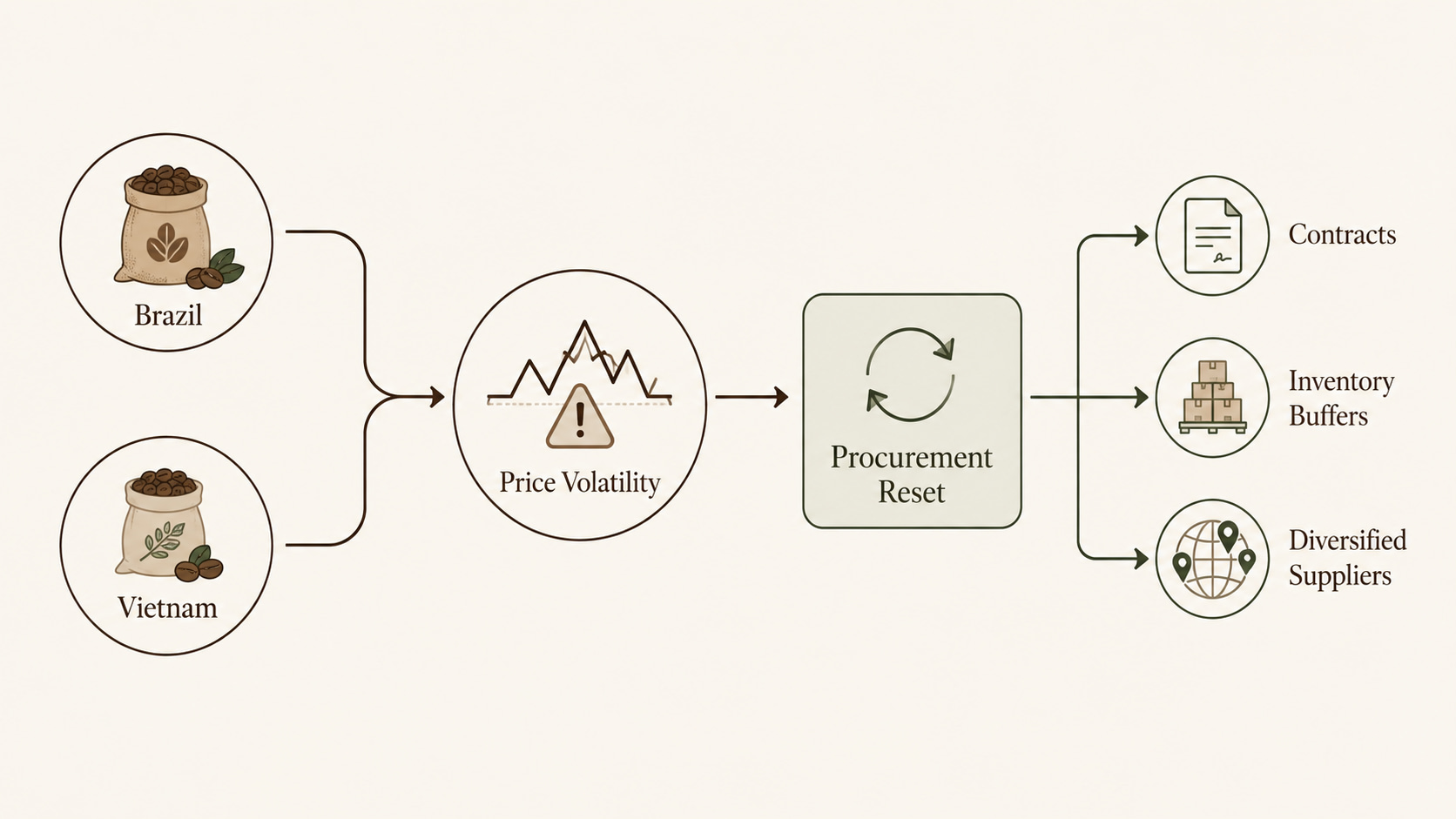
Coffee prices are again forcing companies to look beyond the trading screen. Revisions to supply expectations in Brazil and Vietnam have kept the market sensitive to relatively small changes in crop outlooks, exposing how little room global buyers have when production is concentrated in a handful of origins [1].
For large roasters, beverage groups and retailers, the problem is no longer simply whether coffee becomes more expensive in a given quarter. Repeated swings make the cost of supply harder to plan across contracts, inventories and product pricing. That pushes procurement away from a narrow focus on the cheapest available tonne. The strategic question becomes how much certainty a company is willing to pay for — and how far ahead it needs to secure it.
Concentration Creates Supply Chain Risk
The difficulty is that coffee supply is not broadly distributed enough for buyers to diversify away every shock. Brazil and Vietnam account for roughly half of global production, with each country dominant in a different part of the market [2]. That concentration gives procurement teams fewer alternatives when harvest expectations weaken in both origins at the same time.
The constraint is not only volume. Coffee is not a fully interchangeable input: switching origin or moving between Arabica and Robusta can change flavour, blending requirements and product positioning. That makes substitution slower and commercially more complex than simply replacing one supplier with another.
For large buyers, concentration therefore changes the meaning of volatility. A regional crop problem can quickly become a sourcing problem because there may be no equivalent volume available elsewhere at the same quality and price. The risk sits in the structure of supply itself, not just in the futures market.
Procurement Starts Buying Stability
Once supply concentration makes substitution difficult, procurement has to solve a different problem. The cheapest available contract matters less if the underlying volume cannot be replaced when an origin underperforms. That pushes buyers toward a broader mix of tools: more diversified supplier bases, larger safety stocks and greater flexibility in how contracts are structured.
None of those choices is free. Holding more inventory ties up working capital, backup suppliers can carry a premium, and diversification usually adds complexity to purchasing and quality control. Yet the alternative is to leave the business more exposed to a market where localized deficits translate into global operational disruptions.
OECD research describes redundancy, flexibility and responsiveness as core building blocks of resilient supply chains [3]. For procurement teams, that changes the benchmark. Efficiency is no longer measured only by how cheaply inputs are bought, but by how reliably they can still be secured when the market tightens.
Pricing Becomes Part of Risk Management
Higher coffee costs do not reach consumers immediately. They move through contracts, inventories and hedging positions before appearing in the P&L, which leaves management deciding when — and how far — retail prices can follow.
Nestlé’s 2025 results show that tension clearly. Higher coffee and cocoa costs pushed its gross margin down by 110 basis points, while price increases and cost savings only partly offset the pressure [4]. In coffee, demand remained relatively resilient despite higher prices, giving the company more room to recover part of the cost shock without an equivalent decline in volumes.
That lag matters because margin pressure arrives before pricing can fully catch up. Companies with stronger brands can spread adjustments over time rather than force an immediate reset at the shelf. In that sense, pricing power becomes a buffer between commodity inflation and earnings, not simply a commercial lever.
Supply Chains Compete for Access, Not Price
Coffee is a useful warning for a much bigger reason. When supply becomes harder to replace, companies stop asking only what a commodity costs and start asking whether they can count on getting it at all. That changes what good procurement looks like. In a market with limited alternatives, the lowest-cost option can quickly become the wrong one. Buyers begin to value relationships that survive a poor harvest, a trade disruption or a sudden shortage of available volume. Coffee is part of the same rethink already visible across global supply chains: access matters more when markets offer fewer easy substitutes.
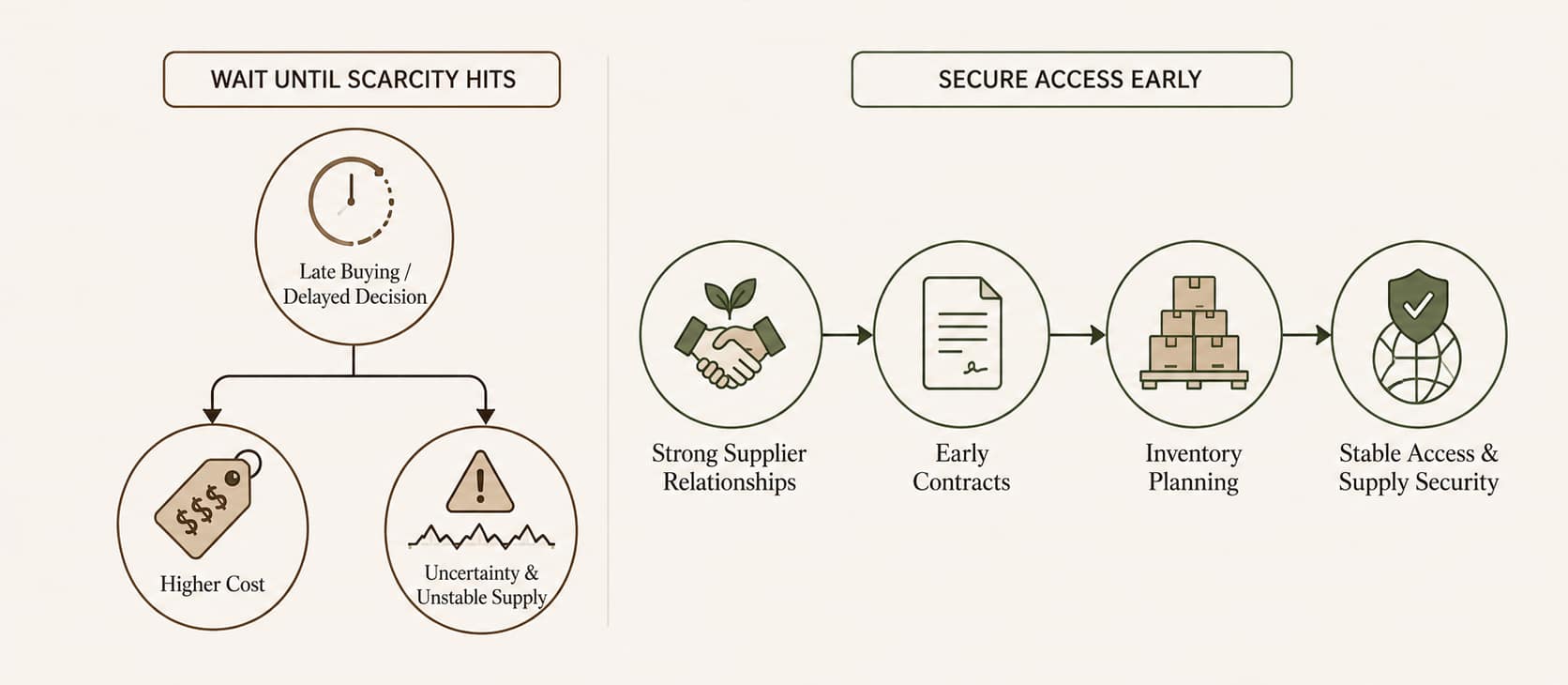
That is the harder lesson behind today’s coffee prices. As cross-sector capital-allocation decisions become more selective, companies that can secure physical supply early gain a clear advantage in managing costs later. Those that cannot are left negotiating after scarcity has already set the price. Scale helps, but not simply because it brings bargaining power. It grants companies the financial capacity to hold stock, commit earlier and stay out of the most expensive corners of the spot market. In a tighter commodity cycle, that may matter more than squeezing the last few points out of the purchase price.
Sources:
[1] International Coffee Organization — Coffee Market Report / Public Market Information
[2] U.S. Department of Agriculture, Foreign Agricultural Service — Coffee: World Markets and Trade
[3] Organisation for Economic Co-operation and Development — OECD Supply Chain Resilience Review
Editor-in-chief at Vireon Press, covering business and technology through the lens of strategy, efficiency, and real-world consequences.

The Schneider PTC Deal and the New Industrial Business Model


The In-House Premium: GE Aerospace and the Return of Vertical Integration

How Brands Can Sell Value Without Sounding Expensive
Shein’s $26B Reality Check: Why Fast Logistics Is Getting Expensive

The Warehouse Correction: America’s Logistics Boom Meets Real Demand
Advertisement