



U.S. Inflation’s Biggest Movers: Transportation 2019-2025
-
By
Arthur Kellan
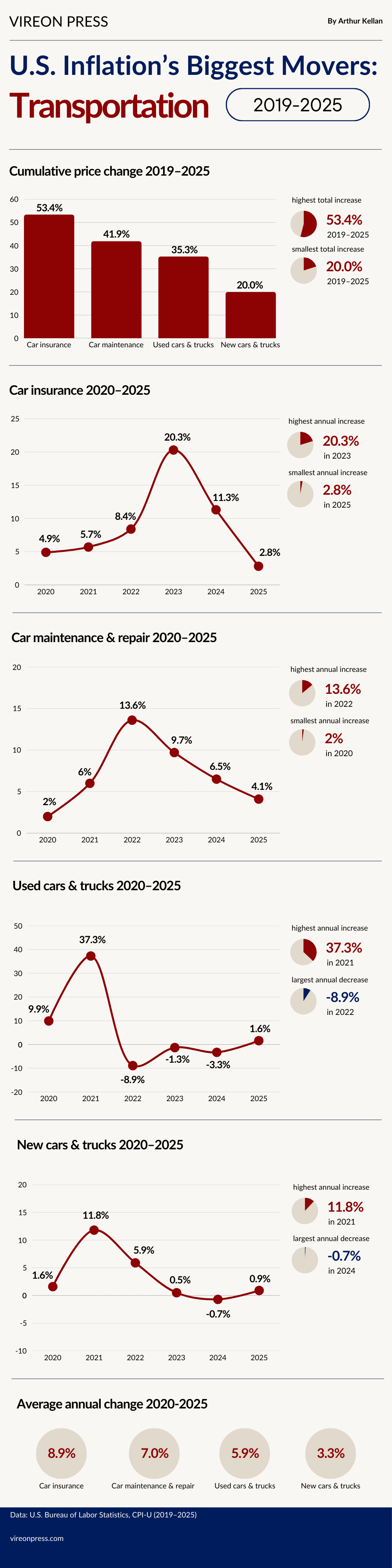
Since 2019, transportation costs have become one of the most persistent sources of inflation in the U.S. economy. While headline inflation often focuses on food or housing, transport-related expenses have quietly climbed faster in several important areas.
Car insurance shows the most dramatic increase, with prices up more than 50% over the period. Unlike fuel or vehicle prices, insurance costs tend to move in one direction. Rising repair bills, more expensive parts, and higher accident claims have created a steady upward pressure on premiums.
Parts and labor costs rise as vehicles get more complicated. Even moderate annual growth accumulates over time, turning basic upkeep into a conspicuous household expense.
Used car prices tell a different story. While the year 2021 saw a sharp spike due to supply shortages, the correction in prices for the following years still followed. But even the volatility itself became a part of the inflation story, revealing how quickly transportation prices may respond to supply shocks.
New car prices, by contrast, remained relatively stable, with slower but consistent growth.
Conclusion
Taken together, transportation costs demonstrate the way inflation does not always result from a single large category but from several smaller ones climbing at the exact same time.
With time, these “quiet” increases alter the true cost of daily life.
Sources:
Car insurance (Series ID: CUUR0000SETE)
Car maintenance & repair (Series ID: CUUR0000SETD)
Arthur Kellan
Discover with Vireon Press

Middle East Conflict Pushes Maersk to Reroute Again

Lockheed Martin and Raytheon Gain as Defense Spending Climbs

