Business Growth Strategies in 2026: What Actually Works Now
-
 By
Arthur Kellan
By
Arthur Kellan
- Business
- # strategies
- 11 min read
-
By
Arthur Kellan
- Business
- # strategies
- 11 min read
If you stand still, your place will be taken by competitors who are more agile than you, right? At the same time, in recent years, the concept of growth in the business context has meant something different than simply entering new markets.
To be more precise, today, investors and customers tend to choose the most viable projects over those that promise the fastest ROI and scalability. This explains why every CEO’s main pain point now is the risk of so-called fragile growth, when even the slightest market fluctuation can cause the entire business model to crumble. Below, we’ll explain how to grow a business in 2026 with minimal investment in resources while gradually capturing new market shares.
Why Traditional Growth Models Are Losing Relevance
Corporate growth strategies that have worked reliably for the past 10-15 years exhaust even the largest budgets in 2026. For example, one of the most frequently used sales funnel techniques – “drive more traffic at the start and get more money at the end” – has broken down at three (!) levels.
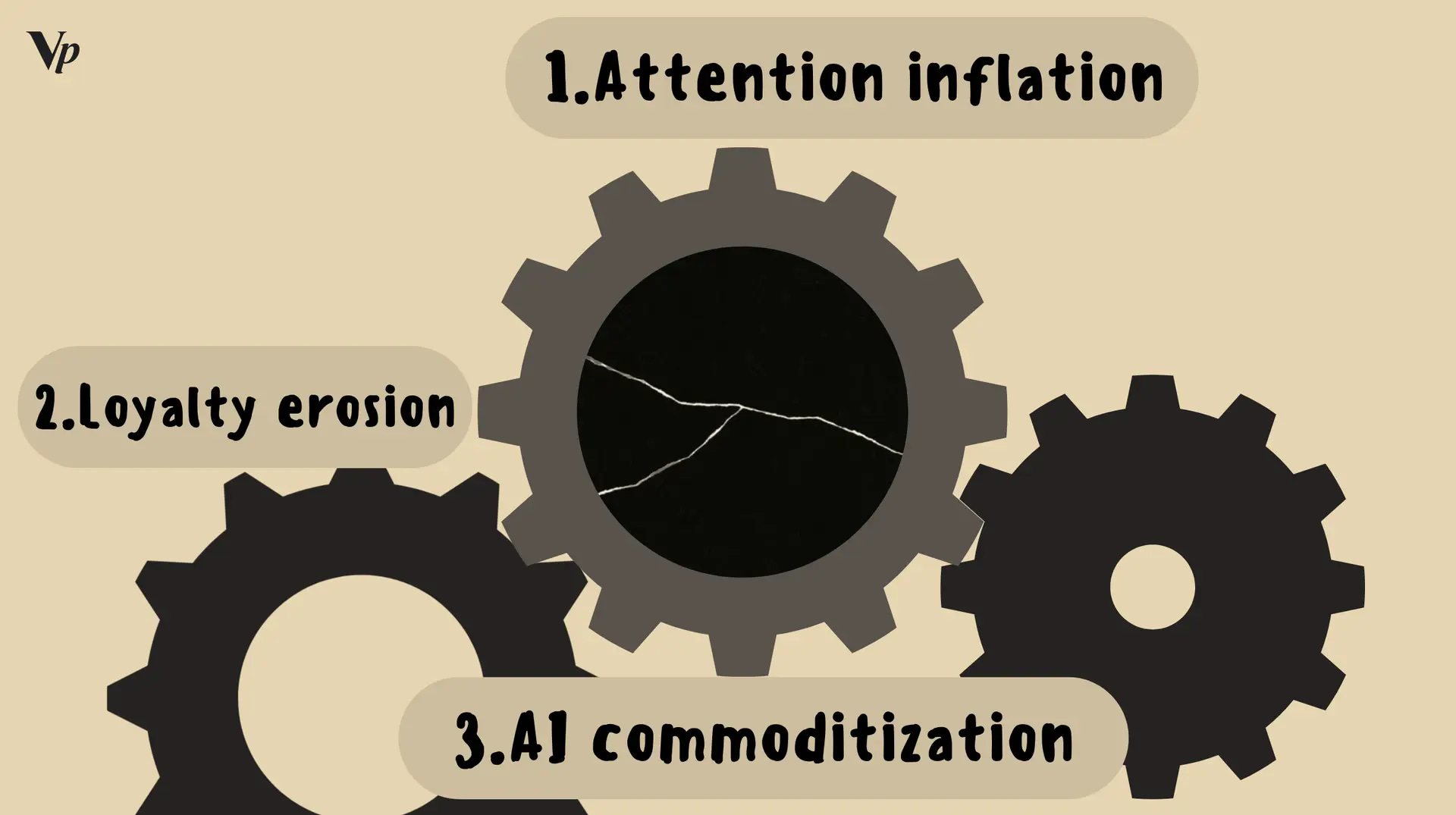
1. Attention inflation
The cost of customer acquisition has increased by an average of 40% compared to 2023 — Upcounting.
This is due to advances in the technologies behind advertising platform algorithms – every competitor now has access to the same targeting and AI optimization tools. In other words, while previously, to get a stable flow of leads for a reasonable price (say, $10), it was enough to target ads to people interested in specific products or services, today, right this second, dozens or even hundreds of companies, including giants, are vying for the same pair of eyes in the feed. This logic, unfortunately, is no longer viable, as doubling a budget, for example, only yields a 10-15% increase in reach.
2. Loyalty erosion
According to Gartner, over 70% of consumers are willing to switch their favorite brand for instant convenience or budget savings. For example, if a customer ordered your lunches for five years, if tomorrow, on the way to work, they see a new restaurant where orders are cheaper and delivered in biodegradable packaging, no one will save their loyalty. In other words, if you still rely on the fact that “people already know you”, you’re simply ignoring modern market adaptation rules.
3. AI commoditization
Just a couple of years ago, the use of AI was a powerful USP, but today it’s not a competitive advantage – it’s a standard feature that any business can implement through free APIs. This means that businesses that still rely on legacy AI automation systems (usually first-generation chatbots and scripts) are gradually irritating their customers because their behavior is perceived as spammy — Techspot.
Sure, you may still be generating some profit from them, but your customer base is already burning out, and within six months, the cost of its recovery will exceed your current profit.
As you can see, the answer to the question, “Why change your approach if it’s still making money?” is becoming clear – in simple terms, your profit from old mechanisms today is merely the liquidation value of your legacy strategy.
Strategic Priorities Companies Are Shifting Toward
In 2026, Tier-1 companies stopped chasing nominal market share at any cost – instead, their KPIs are now focused on the marginality of every move.

Efficiency over scale
Instead of horizontal scaling, companies are massively shifting to vertical scaling, striving to extract maximum value from their existing resources and customer base. This is why the LTV/CAC ratio is a fundamental metric today, requiring a value greater than 4 (instead of the previously acceptable >2). This allows businesses to rely on self-funding without resorting to new high-interest loans.
This practice is confirmed by NVIDIA’s experience (more precisely, their Rubin project): in 2025, instead of increasing H100/H200 chip shipments, they introduced the Rubin platform, aimed at reducing power consumption and the cost per computation by 10 times. By delivering hyper-efficiency to its customers (i.e., data centers), NVIDIA has inexorably tied them to its ecosystem. Now, each of their customers isn’t buying more hardware, but rather a reduction in their operating costs.
Resilience over speed
The old Silicon Valley motto “Move fast and break things” has been replaced by “Stay firm and endure”, which is far more relevant to a reality where supply chains can be disrupted by a single geopolitical tweet. Guided by this, businesses have begun actively implementing the Business Resilience Score, which measures how long a business can operate even with a complete shutdown of external supplies or marketing channels.
This insight is directly confirmed by Tesla’s experience: after the turbulence of 2024, Elon Musk decided to radically change the strategy that had successfully fed him and his shareholders/investors for many years. They slowed the opening of new factories, focusing on converting existing ones into Gigafactories 2.0, which were intended to be transformed into “closed fortresses”.
This essentially became the embodiment of a vertical integration strategy, as Tesla began investing billions in its own lithium processing and cathode production. Today, Gigafactories 2.0 are designed as 100% energy-independent units, using proprietary energy storage systems called megapacks and solar power. In the event of an energy crisis and/or a disruption in component supply, Tesla will be able to continue shipping cars at the same rate while competitors wait for parts from overseas. This is how they managed to achieve invulnerability.
5 Growth Strategies Companies Actually Use Today
Now, let’s look at specific strategies that help companies around the world achieve sustainable business growth despite negative factors beyond their control.
Deep vertical AI
A prime example of this long-term strategy is Lloyds Banking Group (generally speaking, every major fintech player uses it today).
By the second half of 2025, it became clear that simple chatbots weren’t effectively resolving customer issues, necessitating a solution that, in addition to responding to sophisticated requests, could also perform specific actions within a strict compliance framework — BCG.
Therefore, they implemented Agentic AI, which acted as an autonomous node, viewing the financial trail of each client, understanding the context of each request, and independently initiating processes, whether it was reconsidering a credit limit or completing tax forms. As a result, operational cycles were reduced by 60%, and revenue growth was achieved without the need to hire new back-office staff (simply because these AI agents instantly scale to any workload).
The ecosystem play
Like its competitors, Stripe faced an overheated advertising market where selling a payment gateway directly became too expensive. Stripe decided to grow not alongside its customers, but within them, launching Revenue Automation Suite. Stripe thus evolved into a full-fledged business operating system: they integrated Stripe Tax, billing, and reporting into a single stack, enabling startups to connect all this with a single click.
As a result, 69% of users reported a 25% increase in efficiency, and Stripe itself began to grow alongside its customers’ revenue growth.
Hyper-localization of value chains
When it comes to the most striking examples of this strategy’s implementation, the aforementioned Tesla comes to mind first. It decided to confront geopolitical instability and a carbon tax, which together made the long China-EU supply chain economically unviable.
Specifically, as noted above, the company transitioned to the Gigafactories 2.0 model, which entails the complete autonomy of its production hubs. Tesla invested billions in its own lithium processing and cathode production directly at its factories in the US and Germany, achieving complete independence from external disruptions. As a result, Tesla now controls 90% of its value chain, allowing it to maintain margins even with currency fluctuations.
Data monetization through a predictive service
John Deere, which faced oversaturation in the agricultural machinery market and the subsequent decline in margins, has succeeded in pursuing this strategy. Seeking to transform a one-time tractor purchase into a long-term relationship with farmers, the company opted for a leap ambitions approach, connecting over 1.5 million machines to its network by 2026.
Now, instead of just selling tractors, they offer harvest optimization solutions – their sensors analyze the soil in real time, while AI provides seeding recommendations and predicts breakdowns two weeks in advance — John Deere.
Thanks to this, the company has achieved a 40% reduction in equipment downtime and a 40-60% increase in farmers’ ROI. For John Deere, this means a transition to a service model with high margins and customer retention, as customers can no longer switch to competitors, since all their data for 10 years is stored in the Deere cloud.
Selective M&A
Even a giant like Microsoft struggles to maintain leadership in all niches simultaneously. At some point, the company realized it was cheaper to buy existing technology than to spend several years developing it from scratch. Consequently, the company began a series of targeted acquisitions of startups in the fields of Repository Intelligence (essentially AI that understands the context of code) and quantum computing.
Thus, Microsoft decided to fully utilize its vast cash reserves to follow these business expansion trends and acquired teams exhausted by the high-stakes period of 2024. Thanks to this, they quickly integrated a number of new features into Azure and Copilot, maintaining their pioneer status in the eyes of their billion-strong user base.
Common Mistakes in Growth Planning
Mistakes that were previously forgiven due to low competition today lead to immediate loss of stability.

Automation without transformation
Many companies make the fatal mistake of perceiving automation tools – particularly artificial intelligence – as a magic wand that can quickly fix flaws in existing workflows and thereby achieve operational efficiency.
However, automation implemented in an unoptimized business process doesn’t fix it, but rather makes it more expensive. For example, if you simply replace an employee with a chatbot without changing the data architecture and decision-making logic, you’ll end up with a bloated tech stack. It’s also worth noting that such solutions often require additional computing power, licenses, and support specialists. Therefore, without a radical process upgrade, IT infrastructure maintenance costs begin to exceed payroll savings, as the company incurs a huge technical debt that grows exponentially and requires even more people to address it.
Ignoring energy and infrastructure limits
In 2026, growth is almost always a question of physical resources. Imagine the situation: a business sets a goal of 50% revenue growth, planning to scale its cloud systems, but ignores the fact that electricity supplies in the chosen region have already been exhausted. In 2026, an ESG strategy is no longer a social responsibility but simply a ticket to market.
That’s why if your growth plan still doesn’t include a transition to renewable energy or computing optimization, you simply won’t get permission to expand capacity. This means you’ll be able to eventually discover that your supposedly scalable software has hit the physical ceiling of the power grid.
Scaling chaos
The fastest way to go bankrupt today is to try to scale a business model with negative or frontier unit economics. Specifically, the “first we capture the market, then figure out the profits” strategy worked for many years before, but it doesn’t now. If every new product or service sold results in a loss (even a small one), then when scaling, that loss grows exponentially.
The fact is that in 2026, operating expenses are growing faster than ever before, due to inflation, rising salaries for specialized specialists, rising API costs, and so on. Therefore, trying to fix the problem with cash ultimately leads to a cash flow gap before the company can achieve economies of scale. After all, scaling chaos today simply means burning through remaining reserves faster.
What Growth Means for Different Company Sizes
Now, let’s summarize the above and extrapolate effective strategies for 2026 to businesses of different sizes.
|
The company’s size
|
The priority for 2026
|
The success strategy
|
|---|---|---|
|
Startups
|
From zero to revenue
|
Niching and using AI agents instead of staff
|
|
The SMB sector
|
Operational flexibility
|
Removing ineffective branches and end-to-end automation
|
|
Enterprises and corporations
|
Institutional legitimacy
|
Creating ecosystems and investing in resilience
|
Conclusion: Growth Without Excess
As you’ve already realized, growth this year isn’t about capturing and maintaining market share, but about becoming indispensable to your customers. This explains why the winners today are those who can extract maximum profit from every byte of data and every watt of energy.
Therefore, your primary task this quarter is to identify and eliminate the chaos you scaled in 2025 and only then begin implementing your business growth strategies for 2026.

Arthur Kellan
Editor-in-chief at Vireon Press, covering business and technology through the lens of strategy, efficiency, and real-world consequences.