The open signup field was the great consensus of the early product-led growth era. Remove the credit card screen, skip the sales representative, and let the interface prove its own value.
For years, a 14-day or 30-day countdown felt like the natural shape of a software funnel. But friction never really disappeared. It only moved.
By removing the upfront financial commitment, businesses often mistook raw signup volume for commercial validation. Now the average professional already manages too many tools, tabs, and dashboards. A blank account can feel less like an opportunity than another onboarding chore.
This is the friction fallacy behind modern free trial strategy. Zero-cost entry can reduce one barrier while leaving the harder one untouched: the work required to understand the product. If the system fails to show value quickly, the tab closes. The account stays behind as a ghost metric.
Why Free Trials Can Create Low-Quality Demand
An unverified trial user is more than a dead row in a database. When entry costs nothing, it attracts people with very different levels of intent. Some are real buyers. Others treat the software as a temporary, single-use utility.
A professional might sign up with a burner email address to complete one document conversion, export one report, or run one small data scrape. They get the output and never return. The account stays behind, but the demand was never commercial.
That behavior distorts the system around it. Marketing sees more top-of-funnel activity. Product teams inherit noisier data. In a business environment increasingly focused on sustainable growth, ChartMogul’s SaaS conversion research shows why trial models cannot be judged by signup volume alone: free trials, freemium plans, and credit-card-required trials produce different conversion patterns. [1]
Every signup can trigger CRM records, lifecycle emails, tracking events, data syncs, API calls, storage, and support tickets. At scale, “free” access becomes a quiet operating expense, especially when high-value customers wait behind accounts that may never open the product again.
The Real Problem Is Activation
The calendar window of a SaaS free trial can be misleading. A 14-day window can look generous from the company side. From the user side, it often collapses into one short session between meetings, messages, and other open tabs.
A trial has no economic value if the user leaves before reaching the first useful moment. ProductLed describes time-to-value as the time it takes a new user to reach an “aha moment” or activation event, which is why activation matters more than raw access. [2] The product has to make its core benefit visible inside the first session.
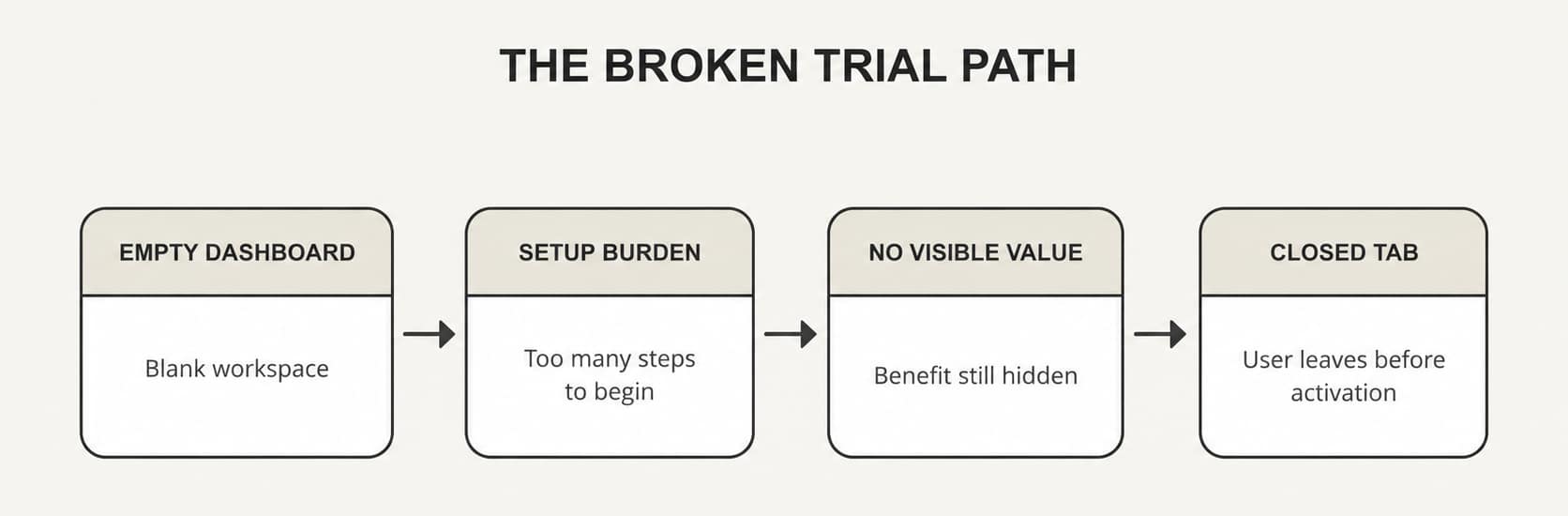
The failure often follows a simple path:
Many products create that path by accident. In trying to prove depth, they overwhelm the person who just arrived: empty dashboards, disconnected charts, advanced toggles, and setup prompts competing for attention. The interface is available, but the value is still hidden behind work.
If a marketing analytics tool asks someone to modify DNS records before showing a basic traffic report, the user may close the tab and return to a familiar spreadsheet.
The product did not fail because the trial was too short. It failed because the first value was too far away.
What Companies Are Testing Instead
To fix the conversion drain, software companies are moving away from the old calendar countdown. The goal is not to add friction for its own sake. It is to place friction where it can qualify intent and help the user see value sooner.
The new models are less about giving everyone the same empty room and more about showing the product in motion.
Interactive demos: The user does not start with a blank dashboard. They click through a pre-filled environment, see sample data, and understand the workflow before giving up an email address.
Guided trials: Access still exists, but it comes with direction. A few focused questions shape the workspace before the interface opens.
Limited freemium and reverse trials: A user may start with premium features, then move into a restricted free plan instead of being locked out completely.
Usage-based access: Instead of limiting the trial by days, the product limits outputs: three exports, five API calls, one connected data source.
These models change the onboarding dynamic. Access is no longer treated as the product. Proof is.
How to Measure Whether a Trial Works
Evaluating a free trial strategy means changing what success looks like inside the business. If teams optimize only for raw registrations, they subsidize empty traffic: accounts that enter the funnel, consume resources, and never become part of a real workflow.
The useful signals are less flattering than signup volume:
Activation rate: The share of trial users who reach the core loop early enough for the product to make sense.
Support ratio: The support and engineering time spent on non-paying users before they show any real buying signal.
Cohort retention at day 90: Whether converted users still use the product three months later, or disappear after the first invoice. Userlens’ 2025 B2B SaaS retention benchmarks frame NRR as a primary measure of SaaS health, which is why trial quality has to be judged beyond the first payment. [3]
A trial is not validated when someone registers. It is validated when the product becomes part of their operating routine.
The Velocity of Value
The assumption that zero friction automatically scales a business has run its course. When thousands of platforms compete for the same block of attention, distribution efficiency is measured less by how easily a user enters the product and more by how quickly they leave with a finished result.
The companies adjusting best to the post-PLG correction treat access less like the asset and more like the liability. Proof is the asset. A free trial that creates ghost metrics, support drag, and subsidized infrastructure cost moves the cost of indecision onto the business.
The strongest free trial strategy is not the one with the longest calendar window. It is the one that brings time-to-value into the first useful session and gives the user a reason to return before the trial clock becomes the main event.
Sources: