Edge Computing: When the Cloud Is Too Far Away
-
 By
VireonPress Editorial
By
VireonPress Editorial
- Technology
- 5 min read
- Technology
- 5 min read
Over the past decade, companies have been actively relying on data centers to optimize computing power costs and scale. However, with the rise of IoT devices, the cloud has faced traditional physical limitations, such as the speed of light and network latency, which have limited the coveted real-time data processing [1]. This is where the need for edge computing emerged.
What Edge Computing Solves That Cloud Cannot
Since the traditional cloud model requires waiting for a request to be processed, this becomes a serious drawback in situations where data is generated instantly across millions of devices.
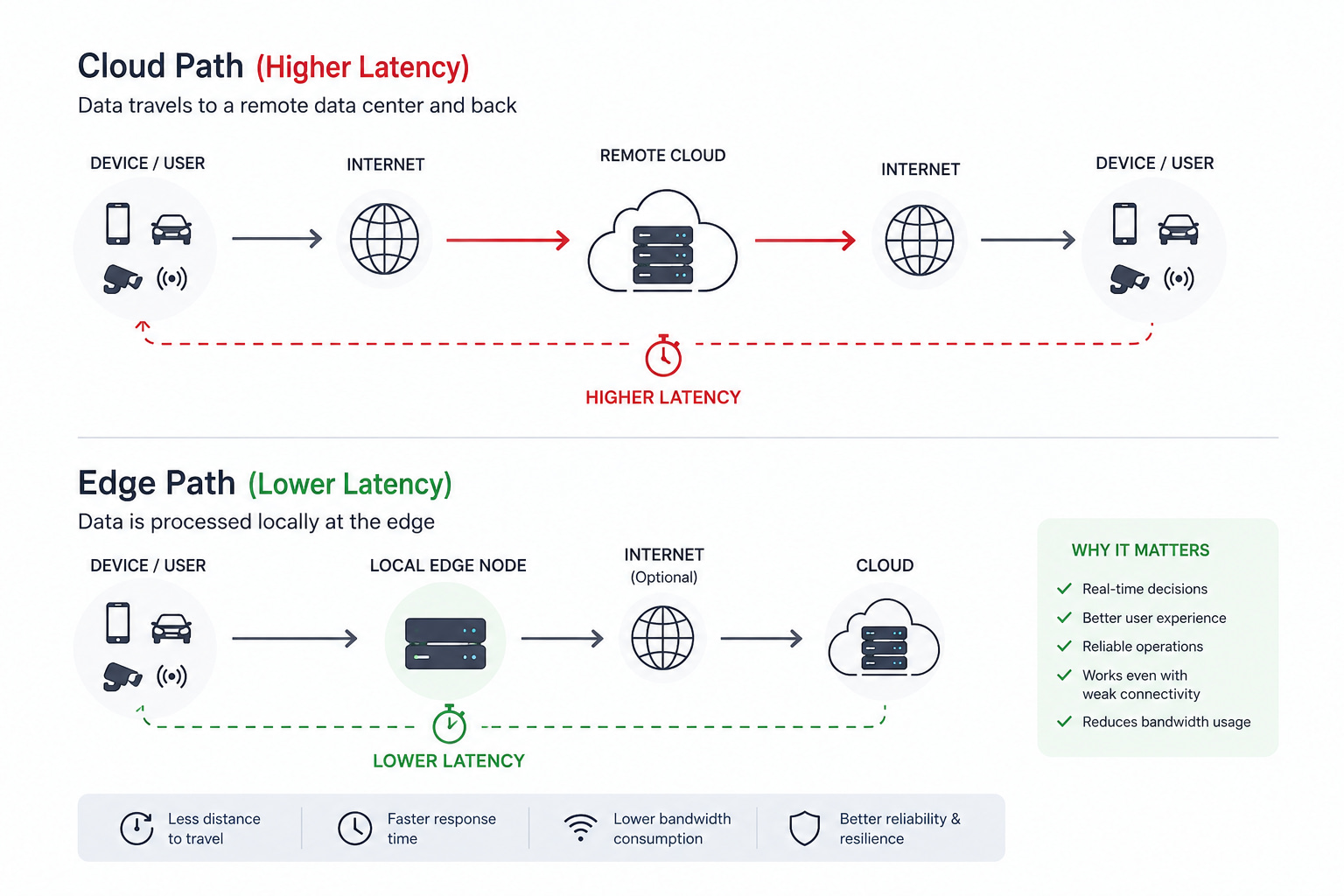
However, edge computing addresses this in three ways:
Determinism. In the cloud, latency always depends on the load on the provider’s nodes and, naturally, the backbone cables. Since increased latency is unacceptable for devices, such as industrial robots or drones (as it could trigger an emergency), this technology enables latency within 1-2 ms.
Bandwidth suffocation. Video streams from 4K surveillance cameras typically weigh several gigabytes. Therefore, in large-scale systems with hundreds of such cameras, ensuring cloud data localization can lead to network congestion – that’s why edge computing enabling local video processing (for example, using AI) is needed.
Local survivability. On an oil platform or in a remote mine, for example, the connection to the central server can be lost at any moment, which is unacceptable from a worker safety standpoint. Here, edge computing comes to the rescue again, ensuring that processes critical to the safety of personnel and equipment are activated immediately, even if public internet access is unavailable.
Mobile Edge Computing and 5G

The advent of 5G networks has given us fast internet on smartphones and created optimal conditions for a global mobile edge computing environment. Here are examples of where it can be applied:
Vehicle-to-everything. For smart cars to communicate with each other and with traffic lights to prevent accidents, data should definitely not be processed in the cloud, which is fraught with dangerous delays. At the same time, a 5G base station at an intersection can coordinate the movement of dozens of cars within a 500-meter radius with zero latency.
Retail using augmented reality solutions. Many offline stores have already implemented grocery shelves where personalized discounts and product listings appear over each product. To ensure smooth graphics, heavy-duty rendering is required, which is implemented using the provider’s MEC node (instead of the customer’s phone’s processor).
Remote surgery. 5G combined with edge computing ensures transmitting of real sensations, meaning a doctor located in London could control a robotic arm in a clinic thousands of kilometers away, feeling tissue resistance through tactile gloves. This is made possible because the signal travels only a few kilometers to the nearest edge server, rather than having to circle the globe.
Latency as a Business Constraint
In the digital economy, latency has become a severe business constraint – today, a latency of 100 ms becomes a barrier to entry for many companies.
For example, in high-frequency trading, where microseconds are at stake, a delay in price transmission can lead to trades at unfavorable prices, making edge computing the only way to remain competitive. Also, it’s worth mentioning the industrial IoT, where, for example, on automated production lines, a delay in signal transmission from a sensor to a controller can increase the defect rate and, as a result, cause downtime for the entire production line, which could have been prevented with edge technologies.
Finally, in customer experience, a page load delay or a lag in cloud gaming of more than 30-50 ms often leads to a sharp user churn. To prevent this, edge computing is also used.
Cost and Infrastructure Trade-Offs
The transition to an edge architecture always requires cost optimization to achieve the desired level of performance. From this perspective, the cloud benefits from economies of scale, while the edge requires distributed investments. Specifically, instead of a single, all-encompassing cloud contract, companies must purchase hundreds of smaller nodes, which increases initial capital expenditures. Furthermore, maintaining a distributed architecture can be too complex for the average system administrator. While replacing a disk in a central data center is a routine task, sending a technician to a remote communications tower or wind farm to repair an edge node will be more difficult and cost tens of times more.
It’s also important to remember that each edge device is a potential attack vector, which, unlike cloud servers, isn’t protected by the data center’s security perimeter. Therefore, in addition to deploying the technology itself, companies also need to implement a zero-trust architecture.
Edge vs Cloud: Complement, Not Replacement
The main misconception is that the edge can replace the cloud in absolutely everything. In fact, the edge is good for tasks that require instant processing and noise filtering, while the cloud is good for tasks that require accumulating historical data from all edge nodes and conducting deep learning. So, let’s look at specific examples below.
|
Task
|
Where it’s better to perform
|
Why it’s more efficient
|
|---|---|---|
|
Real-time analytics
|
Edge
|
A response time of <10 ms is required
|
|
Data filtering
|
Edge
|
Lower traffic costs are ensured, as 90% of junk data is filtered out
|
|
Model training
|
Cloud
|
It requires massive computing power, such as GPU clusters
|
|
Business intelligence
|
Cloud
|
Access to data from all branches for global reporting is needed
|
|
Archive and compliance
|
Cloud
|
Cheap long-term storage of large data volumes is needed
|
Conclusion: Computing Moves Closer to the User
Ultimately, for businesses, the cloud vs edge computing choice is no longer a one-or-the-other dilemma. Instead, a hybrid approach using cloud for knowledge accumulation and computing at the edge for instant action is far more beneficial.
Sources:
VireonPress Editorial
Discover with Vireon Press

Building Before the Demand: ASML’s Long-Term Semiconductor Bet

The End of the Open Market: When AI Starts Buying Years Ahead